
The painting Between Two Worlds not only represents a cowboy’s struggle to hold onto his land and livelihood, but also artist Bill Anton’s personal journey westward.

The scenery, the scent, the colors, the mood, the people who live off the land: these elements drew painter Bill Anton from his native Chicago, Illinois, to Arizona in the mid-1970s. They continue to be the subjects depicted in his paintings.
Painting historic scenes has never interested Anton. When possible, he prefers to participate in and witness firsthand the cowboys and Western lifestyle he paints. However, his commitment to artistic development often keeps him out of the saddle and in the studio. But that was a decision he made more than 25 years ago.
“I knew I couldn’t be a ranch cowboy and an artist and do both well,” he says. “So I chose to paint the modern-day West. I felt the genre deserved undivided attention and should have the highest artistic standards I could muster applied to it. I guess I don’t multi-task very well.”
It’s not enough for Anton to take several photographs at a ranch and paint from them. He aspires to a higher level of artistry. Nocturnal scenes are his favorite to paint because of their difficulty.
“The biggest challenge of painting a nocturnal scene is subduing the color enough that the painting is beautiful, but not overly colorful,” he says. “You have to ride the line between reality and romanticism to make the painting interesting and to evoke the feeling of night without making it too saturated in color. The best paintings are subtle.”
The artist says a finished painting conveys only about 10 percent of the work he has put into it. He devotes a lot of time to preliminary work and studies. As he does with all his paintings, Anton started Between Two Worlds by creating several thumbnail sketches that he rearranged like puzzle pieces until he found the perfect composition for the painting. On complex paintings, he may also paint one or two full-color oil studies.
“I don’t want to dive into something I’m largely composing in my head, because I just don’t know what problems or challenges might emerge,” he says. “If I can work out the details in small sketches, then it will probably work out in a larger format.”
One of the challenges Anton encountered with this painting was making the vast sky and clouds complement and enhance the composition without taking over the painting.
“The story isn’t the clouds or the sky, even though they’re a large part of the painting,” Anton says.
The artist intended for this painting to be a metaphor for his life. The cowboy is sitting on a bluff with his horse. His back is to the encroaching city lights, just as Anton turned his back on the urban environment in which he was raised and headed west.
“My goal isn’t to create something as realistic as possible, but rather to evoke an emotion,” Anton says. “I hope people see a well-composed painting that is restful but also has a bit of an edge to it, with thoughts of encroaching urban life.”
Though the story behind the painting is apparent, Anton’s loose, sophisticated brushstrokes leave much to a viewer’s imagination. He edits his scenes with painstaking scrutiny, striving to “say more with less” detail.
“The nonessentials left out have far more to do with art than what are put in,” he says. “Ned Jacob once told me that if you think your painting needs something, take something out.”
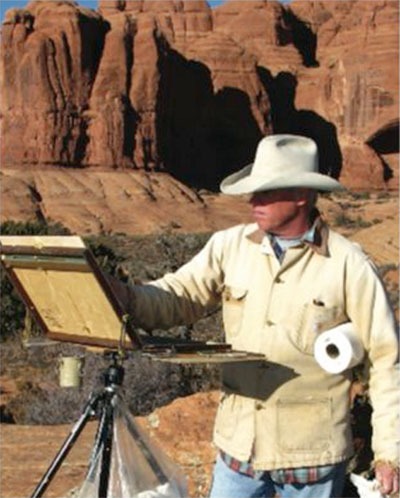
Anton began painting landscapes more than 20 years ago and was quite accomplished at it. He learned that everything he needed to know about painting was applied whenever he painted outside.
“I’ve never known anything as important as painting en plein air,” he says. “That’s the only real classroom I had other than a few workshops. Painting outside teaches you more in a week than years in the studio. It becomes an exercise in problem-solving, which is what painting is all about.”