

In days gone by, all it took to start a cow outfit were roping skills and a running iron.
For centuries, branding has been essential for proving ownership of livestock. In the open-range days of the cattle industry, many a rancher got his start by applying his brand to unclaimed or wild cattle, or branding slick claves that didn’t follow their mothers.
“A lot of herds have been started with a fast horse, a long rope and a running iron.” says Montana horseman Paul Woods.
As branding become more common, ingenious rustlers quickly figured out ways to obscure brands on cattle hides by using a cinch ring, horseshoe or bit heated in a fire. They also used running irons – slender metal rods with curved tips or metal rings that could modify almost any brand.
There are myriad instances of freehand brand alterations using running irons, including C being changed to O, F to E, R to B, I to T, Y to X, and so forth. Because of their affiliation with rustlers, running irons are frowned upon by brand inspectors and are now largely illegal.
“It has always been sort of taboo in my experience to carry a running iron,” Wood says. “A cowboy generally caught with a running iron was looked at much the same way as a man caught with burglary tools.”
However, running irons have been used, and still are on occasion, by legitimate ranchers as a tool of convenience to brand stragglers or late calves that turn up in areas hard to access with proper branding equipment.
“Branding with running irons was something we did when there was no fences and cattle would end up hundreds of miles from the home ranch,” recalls 78-year-old Elko County, Nevada, brand inspector Jim Andre.
Andre began buckarooing on the Spanish Ranch in the 1950s, worked on the TS Ranch, and was the manager and buckaroo boss at the IL Ranch.
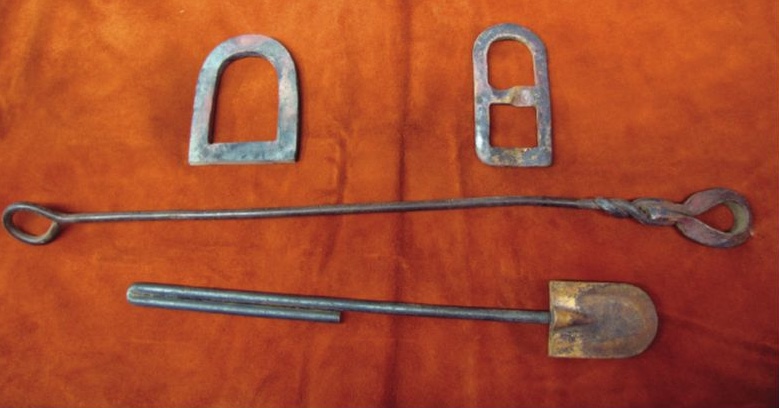
to apply their LOV brand on remnant cattle. Through the years, Brennan has collected old running irons,
which are hard to find.
“The IL ran cattle on more than a million acres, so it was common to miss a calf at branding,” he says. “So we’d use a running iron back then. Before the [Bureau of Land Management] owned the wild horses, a lot of guys would use running irons to claim wild horses for ranches.”
Andre says he still sees a few running iron brands used on late calves in Nevada, but it’s against the law to carry and use the implement.
Although they are illegal now, Arizona cowboy and author J.P.S. Brown recalls ranchers using running irons to build their cattle herds when he was growing up.
“During my great-grandfather and grandfather’s time, this country was running wild with cattle,” explains the 81-year-old cowboy. “They built a herd of 33,000 cattle from roping and branding wild cattle.”
Brown explains that in those days, maverick cattle less than 6 months old that weren’t branded or running with a branded mama belonged to the government, but unbranded cattle older than 6 months were fair game.
“It was hard and awkward to carry a branding iron, so they carried running irons so they could brand what they caught,” he says. “When [the brand] healed and peeled, it was legally theirs.”
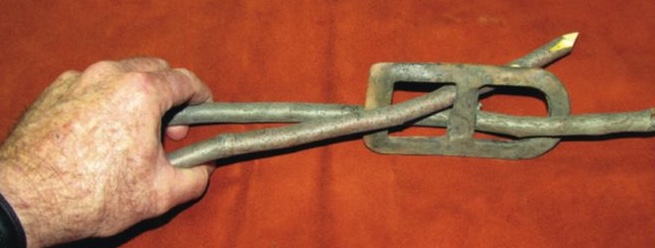
Saddle maker Mike Brennan grew up on his family’s ranch along Piceance Creek in Meeker, Colorado, and says he and other cowboys always carried one or two running irons in their saddlebags or in a case secured to the back of their saddle cantles. They sometimes used running irons on late-spring calves or when calves would get in the long, deep gulches not accessible by motorized vehicle.
“We didn’t use a circle or bent rod like you see most of the time,” he explains. “We used a manufactured copper iron called a Violet Iron, named after Tex Violet of Fruita, Colorado, who made it. We’d build a little fire, cut sarvis berry or choke cherry sticks for handles, and rope and drag calves to the fire. One guy on the ground would fish out the running iron, place the sticks through the ring in an X and brand the calves. Our LOV brand was easy to do with a running iron.”
Both Brennan and Brown have running iron collections. Though neither cowboy carries one any longer, the notorious irons represent a lost practice used during a wilder time in the West.
This article was originally published in the April 2012 issue of Western Horseman.