

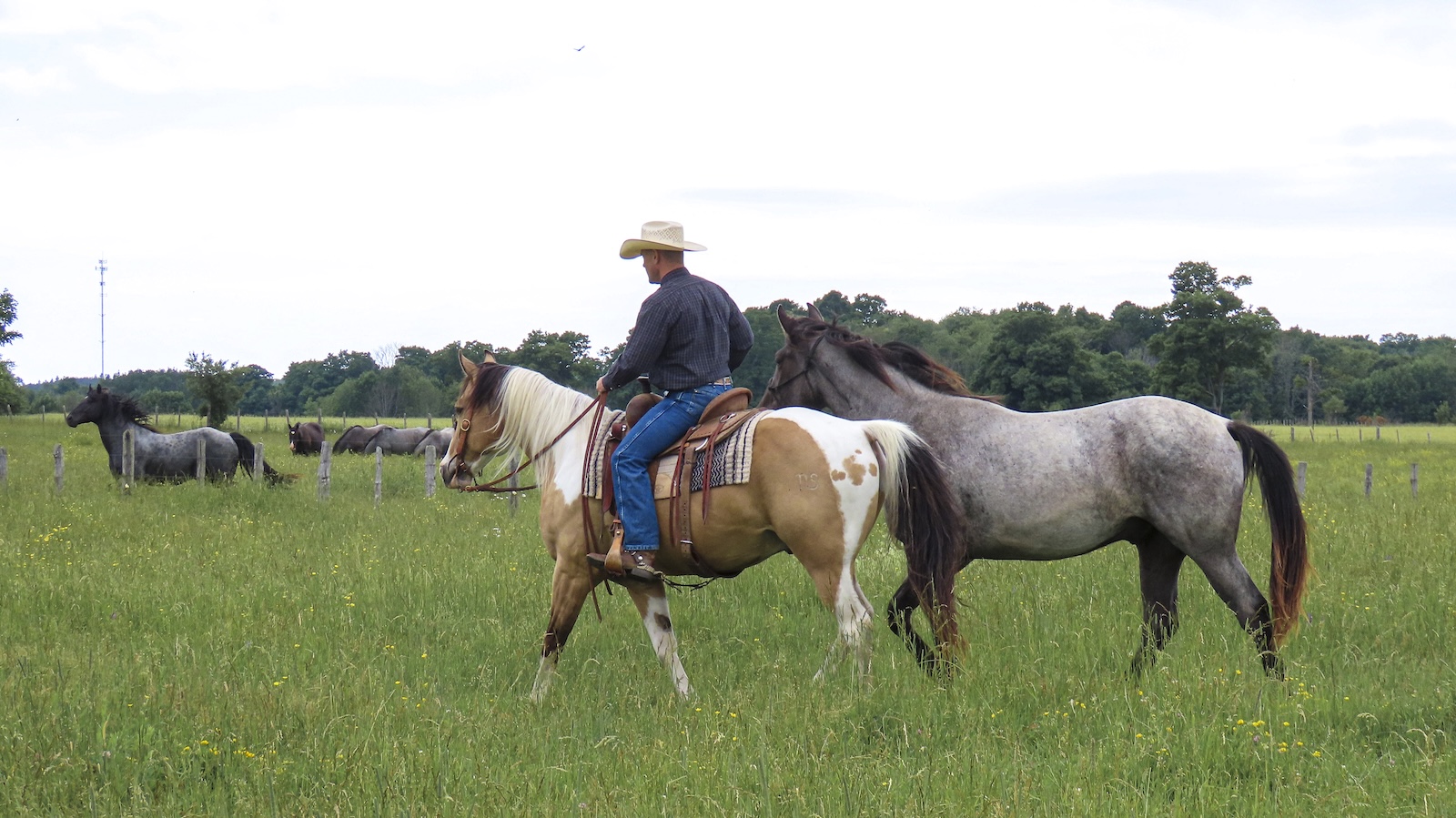
When it comes down to it, it’s not that difficult to teach a horse to lead from another one, but there are a few things to keep in mind that will help the task go smoother and safer.
There are many reasons to pony (lead) one horse off of another. I personally like it for teaching young horses to move freely forward and to help prepare them for being ridden later in their training. I also like it for working with older horses that haven’t been taught to lead very well and have learned how to pull people around on the ground. For this article, I will refer to the horse that I’m leading as a colt, but it can be any age of horse.
When you start this training, my first piece of advice is to get moving. The longer you stand still, the more time the colt has to shuffle around and get himself wrapped up in the rope or some other trouble.
Assuming the colt is on the right side of the saddle horse, start by riding a big circle to the right. Typically, young and timid horses want to hang back. By going to the right, the colt inside the circle doesn’t have to cover quite as much ground as the saddle horse. If the colt is hanging back, give little pulls on the lead rope to bring him forward. As the colt gets the idea, ride ahead in a straight line.
In the very beginning, I don’t like to turn to the left because that will position the hip of the saddle horse towards the colt. The colt might think the saddle horse is lining up to kick him, so he will pull back. However, this won’t be a concern once the colt learns the routine.
I hold the lead in my right hand and try to use quite a bit of feel on the rope. However, if the colt is pulling or setting back, I will dally the rope around the saddle horn to keep hold of him and bring him forward. A person should ride a solid saddle horse for this job. If things get a bit hectic, you want to be sitting on one that is reliable. It would be even better if your saddle horse is a fast walker because this will encourage the colt to step out and move freely.
Once this is going well, make a point of stopping and petting the colt. The colt should stop when you stop, but if he keeps going, give the lead rope one or two quick bumps to make him put the brakes on. Only stay stopped for a short time, and then get moving again.
If you’re at a standstill and the colt starts to swing his hind end away from you, turn your saddle horse slightly left and immediately ride forward. This pulls the colt around and straightens him back out, which keeps him from getting wrapped up with your saddle horse.
Once he’s stopping well, then reach down and lightly pull on the lead to ask the colt to back up. It’s not mandatory, but you can add in the word “back” as you do this. I would eventually like to build up to where I can stop my saddle horse and start backing up, and the colt stops and backs up beside me without needing to pull on the lead at all. This shows the colt is really paying attention, and it’s a good exercise for teaching him not to pass the saddle horse.
If the colt backs up very crooked, position him between your saddle horse and a high fence. When you ask for the backup, he won’t be able to swing his hind-end either direction because the horse you’re sitting on keeps him contained on one side, and the fence is doing the same thing on the other side. He will have no choice but to back up straight, and after a few lessons, he will do it without needing the help of the fence.
Once the leading is going well, you can step it up to a trot. I don’t want to drag the colt along, but if he’s being really lazy and sluggish, I will speed up and trot for a minute. Then I’ll drop back to the walk, speed up and repeat. These quick periods of faster speed get the colt engaged and paying attention. Eventually, you could work up to the lope, but don’t rush into that because if the colt is loping and then suddenly hits the brakes or sets back, it will give you quite a jolt.
Make a point of rubbing and petting the colt around the neck and head when he’s standing still. If he is head shy or touchy about his ears, this is a great time to work on that because he can’t lift his head to get away from you the way he could if you were standing on the ground. Also, lean over and rub the colt on his back. This helps get a young horse used to seeing someone above him and leaning over him, like he will later when he’s ridden for the first time.
This could be taken a step further, and the rider could desensitize the colt with a saddle blanket or flag while sitting on their saddle horse. This could be a big help if the colt is strong and tends to drag the handler around on the ground because he can’t pull the other horse around. However, it’s easy to get in trouble if you’re trying to ride your horse, hold on to the colt and hold onto another tool at the same time, so only try this if you feel you’re handy enough to get it done safely.
I mentioned that some colts might try to rush past the saddle horse. In this case, I would trot several small circles to the left. This way, the colt must cover much more ground than the saddle horse, and he’ll start to learn to slow down and stay in position. Another option is to let out a bit more rope and make some quick turns to the left as the colt tries to speed by. The colt will run into the halter as he rushes by, be pulled slightly off balance and quickly be re-positioned back where he should have been in the first place. Usually, this only has to be done a few times before they get the idea.
Once your colt is doing well, you can pony him down the trails or out wherever you want to go. This is a nice way to show a young horse the sights. If the colt has been saddled before, you could pony him with his saddle on to help get him even more used to the idea of being ridden outside. You can also pony your colt over logs, through water, etc. However, when working over obstacles, take your time and help the horse along instead of just dragging him over everything in his path.
One last point — like every other type of training, ponying can be overdone. When things are going well, call it a day and start again tomorrow on a good note.
Good luck to you and your horse!


Very interesting article. I have been wanting to try to pony my yearling but wasn’t sure how to safely begin. Jason’s explanation and insights are very encouraging and give a better perspective on how to safely try ponying a youngster.
Thanks kindly!
Sandy Zylstra
I have ponied all my horses, young and old. It builds my confidence and theirs as well. I know what their reactions are before I get on them as my riding is out in the open since I don’t have a round pen or arena