

“We put bits int he horses’ mouths, that they may obey us and we turn about their whole body.” — Epistle of St. James.
“STOMACH PUMP,” snorts the cowboy from the East Slope. “How barbarous,” shudders the new arrival from the Effete East, “isn’t it very cruel?” Only two samples of the many mistaken ideas about the Spanish bit and its raison d’etre. Its name is misleading. Not a Spanish bit at all. Designed first by the nomadic horseback tribes whose forbears were cradled in the great valley of the Tigris-Euphrates, men who needed a bit to control horses in hand-to-hand fighting. The Mongol Horde brought the crude idea to Europe. The mail clad knights of Christendom improved it. In one shape or another, its principle is known and used in every country where often men’s lives depended on their skill in horsemanship and with weapons.
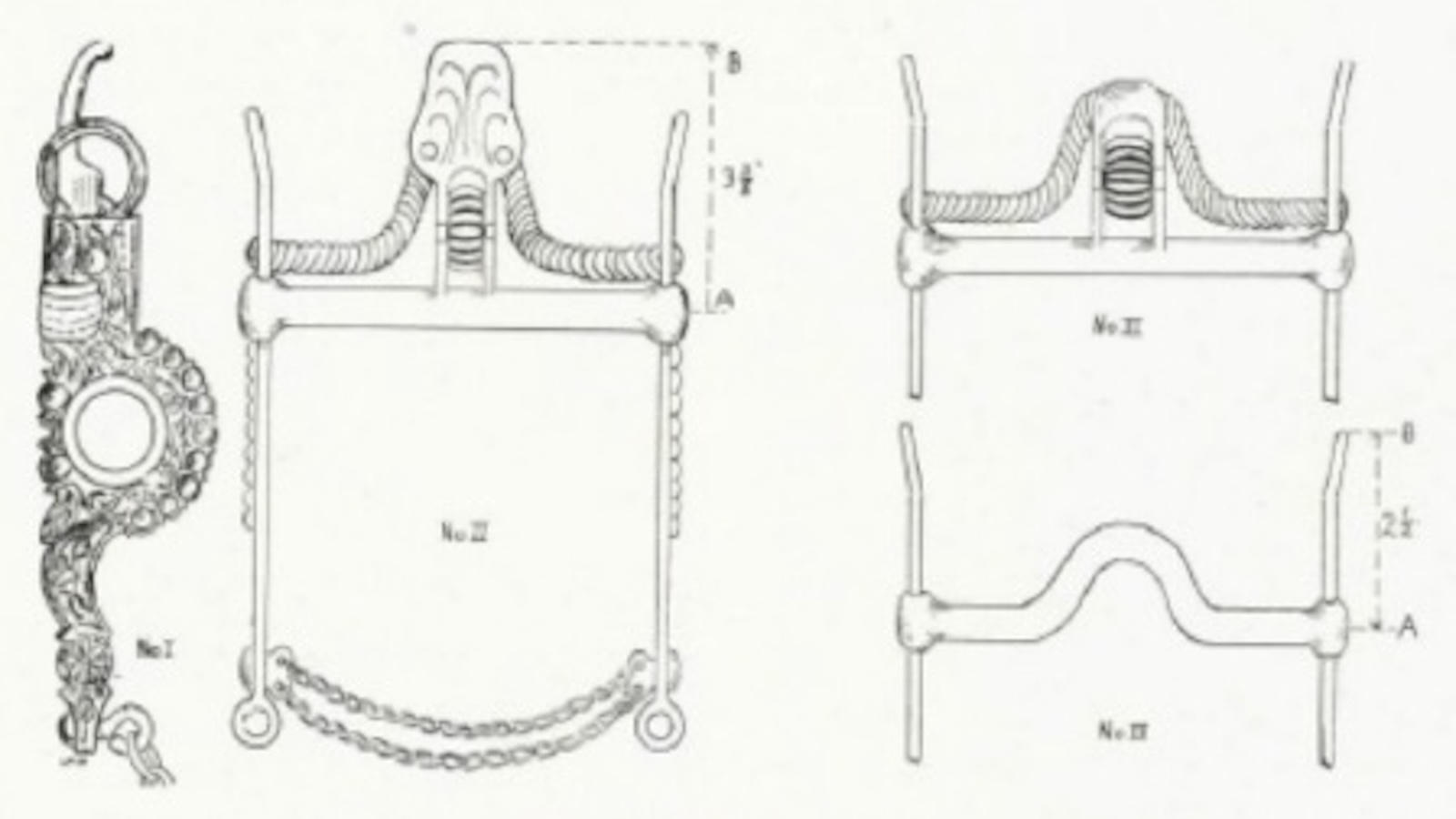
Perfected by men who studied the reactions of horse nature to the demands of a rider. In the heyday of chivalry, two braces or side arms were added to the bit to prevent an ignorant groom from drawing the bit too high in the horse’s mouth. To be effective a bit must lay in the right place across the bars of the animal’s mouth. And it must stay in position. The side arms of the spade keep it there. The roller in the port is a very old idea, the horse likes to roll and champ it with his tongue and thus he helps to mouth himself. Sometimes a roller was added to the top of the spade — with many horses this proved to be good. Differing styles of cheek plates and mouth pieces were evolved, tried, adopted, discarded. The bit was expressly designed to give a rider who needed one hand free to handle weapons with, complete control over his mount.
No proof exists on how much or how little Spanish horsemen had to do with the evolution of the spade nor do we know exactly the form in which the Moors brought it to Spain. But one thing we do know — despite popular belief, the Dons did not use the spade on all horses. For one thing, fashions in bits varied from time to time and a gentleman had to be in fashion. Then some horses would work better in differing styles of mouth pieces, even as they do today.
So, when ranching began in California, the padres at the Missions taught their Indian converts to forage bits and spurs. From the first they made up three varying styles of mouthpieces. The full spade, favorite with skilled, light handed horsemen, then a half breed in two patters and a plain bar mouth with an arching open port in the middle, this being designed for Indian vaqueros and men and boys unskilled in horsemanship.
Horsemanship was a serious study and many difficulties beset the bit makers. Cheek plates used in Spain proved unsuitable for California horses. Ranch bred mounts developed an uncanny knack of grabbing the narrow arms of some popular Spanish patterns in their teeth, thus defeating control. This problem attracted the attention of Don Jose Francisco de Ortega, the commandante of Santa Barbara. The Don had a bit brought from Spain and a few trials with it on some of the trickiest horses raised in the Santa Yñez Valley proved its flat cheek plates could foil the wiliest caballo. So the bit makers at the Mission copied this pattern, soon these bits spread all over California, even into Texas and became known as the “Santa Barbara” style.
They were loose cheek bits, easy to make, graceful in their simplicity, so effective that hey became practically the standard for all spade bits, wherever made. But they were made of iron, when the side slots became worn the bit would pinch the horse’ slip and mouth so much that it would flinch from control. So stiff mouth, riveted bits were introduced, but the best of them were not as effective as the “Santa Barbara.”
Country blacksmiths worked out various methods of repairing, for in spite of its drawback this bit was so good that particular reinaderos would have nothing else. Even today, this old style Moorish bit is reckoned to be the very best for fancy bridle work.
But their weak point is still the same. The ends of the mouthbar are bent round a narrow strip cut in the cheek plate. Even when forged from good steel this wears loose and then pinches a horse. So, a few years ago, an oldtime California saddlery firm, The Visalia Stock Saddle Company, brought out the one and only improvement that can be made in this bit. They applied a patented extension feature to the mouth bar and built “hinge-bars” in the cheeks in such a way that no wear can take place. In fact the bit could be guaranteed for a lifetime of use. One curious point about this “Santa Barbara” is the proven fact that the shape, style and sizes of the cheek plates cannot be improved on. These plates date back beyond the days of the Cid and even in their ornamentation not the slightest change has been made.
Research in old saddlery catalogs shows over four hundred styles of mouthpieces and cheek plates listed. In several catalogs this Moorish cheek plate is illustrated, captioned as the “Santa Barbara” and described as being especially suitable for training young horses. Scholars tell me its design and ornamentation are typically Moorish and that many references to it exist in old manuscripts. The best spade bit riders I have met all say it is the finest of all the many bits designed.
It has traveled from the Far East to Europe, then to the New World. Eight years ago I saw one found when exploring an abandoned Spanish mine in New Mexico. A year or two afterwards, a Texas ranchman gave me one which was turned up in digging the foundation of his ranch home. In British Columbia an engineer showed me another which he had found in Peru. And all three of these ancient bits were exactly like the modern bit just made up for me. The same shape, the same mouth, exactly the same style of ornamentation. And when the oldtime Spanish-Californios, the “Boys of the Old Brigade,” see this, my new bit, they tell me it’s the real California style — the best and easiest bit for a horse that man can make.
Don Jose Francisco de Ortega, the first commandante of Santa Barbara, introduced it to favor in Old California, from Santa Barbara. On its own merits, it spread all over the West and into Mexico. Today, for those who will study the ways and whims of a horse, who believe with the Sieur de Busigni, that, “Ce n’ est pas la main légerè qu’il nous fait c’ est la main savant” — “not the light hand but the skilled hand that is needed,” then, for them, this old “Santa Barbara” is still the best bit of all.
This article was originally published in the January-February 1937 issue of Western Horseman.




I particularly appreciate the description of the difference between the basic Santa Barbara and the Visalia variation. The writer does not mention the versions that replace the wider (no grab) cheeks with the S shaped cheeks, which of course are also used on other curb bits.
I have Fleming bit, which I (now) know is not a very well-designed version of the Santa Barbara. I never used it because the horse I bought it for never got out of the snaffle. Probably just as well, but it makes a nice paperweight.