


The offer was so far-fetched that, if true, it was an adventure Moore couldn’t pass up. Thirteen days later, he was on board the Murray Express, a 240-foot livestock cargo ship, waving bon voyage to America.
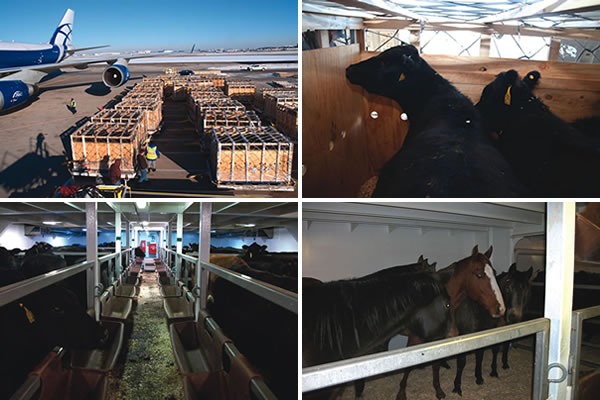
The first few days at sea were tranquil. Moore made rounds through the ship’s three stories of livestock pens, checking on the cattle and horses. He spent his free time taking pictures of the ocean and getting to know the ship’s crew, all of whom were Filipino. The Murray Express, like most international cargo ships, is “flagged” in the Philippines where laws are lax and labor cheap. According to a 2009 report, one-third (330,000) of the world’s sailors are Filipino. Moore saw why; the crew worked hard around the clock, operating the ship and caring for the livestock.
Under clear skies, the ship made 10 knots (11.5 mph), the speed at which it would travel the 7,500 miles to Novorossiysk in 26 days. But half way across the Atlantic, the ship sailed into a storm. Monster 30-foot waves rocked the boat, pummeling both man and beast for several days. Moore, between bouts of seasickness, went below decks to check on the animals. They were woozy and filthy, shellacked in a concoction of mud, wood shavings and manure.
“It looks like they’ve been through a washing machine of s—,” he wrote Darrell in a satellite e-mail.
The calm after the storm didn’t last long. After passing through the Strait of Gibraltar, the gap between Africa and Europe that marks the beginning of the Mediterranean Sea, another storm hit, this one making international news. The Adriatic, a cargo vessel hauling scrap iron, sunk off the coast of Israel. The 11-man crew escaped in life rafts. Three more cargo ships were pummeled so badly that they needed to be towed into port for repairs. And a Royal Caribbean cruise ship, Brilliance of the Seas, was tossed about like a rubber ducky in a storm gutter, traumatizing its passengers.
The Murray Express chugged headlong into the storm. The ship bucked and kicked so hard that Moore retreated to his bunk for safety, holding onto handrails fastened to the bed frame for stability. He stared at the ceiling to fight off nausea, watching the window curtains swing away from the wall at 30-degree angles and then back flush in rhythm with the rocking ship.
The Murray Express arched around the boot of Italy and threaded through the Greek Isles, still six days from making port in Russia.
MEANWHILE, DARRELL, Yury, Kate and I flew to Russia. The number of airline passengers wearing cowboy hats dwindled as we went east: seven hats in Billings, four in Salt Lake City, and in New York a man wearin
g a fedora deserved honorable mention (for bravery, if not fashion sense). By the time we deplaned in Moscow, it was just Darrell and me sporting our best black felts. A curious Muscovite approached Kate and asked where we were from.
“Они американские” (They’re Americans), she said. The man nodded approvingly, like he expected all Americans to wear cowboy hats.
We loaded into a passenger van and drove straight south to meet the Murray Express at the Port of Novorossiysk on the Black Sea. The Russian countryside was astonishingly beautiful. Humpbacked hills breeched through stands of birch and lodgepole pine forests. Much of the land had been cleared for agriculture, and yet we saw only a few fields planted in cover crops or winter wheat. The vast majority of it sat fallow, and there wasn’t a cow, horse or fence line in sight.
“It’s the closest thing I can imagine to what the American frontier looked like,” Darrell said.
Something didn’t add up: so much vacant land and so few cattle, and yet a national beef crisis. To understand it, you must look back on key events during the 20th century that dealt successive blows to the Russian beef industry.
During World War I, Tsar Nicholas II requisitioned 4 million head of livestock to feed the military. In 1917, the Communist Party overthrew the Tsar during the Russian Revolution, but the beef industry didn’t fare well afterward. Vladimir Lenin, leader of the newly formed Soviet Union, seized private land and cattle in the name of the Russian people, a tenet of communism.
In the region where Stevenson Sputnik Ranch is located, the peasants resisted, but Lenin’s ill-tempered successor, Joseph Stalin, waged genocide against them during the “Terror Famine.” Soviet agents seized property, sent those who defied the system to gulag work camps in Siberia, and blockaded the delivery of food, effectively starving the peasants into submission. An estimated 5 million people died, and those who survived had picked the land clean of what meat they could find.
In the 1940s, the Soviet Union rebuilt agriculture under the direct control of the Communist Party in Moscow. The Party consolidated large tracts of land into “collective farms,” giving them lofty names that rang with propaganda, such as Red Giant Farm and Farm Victory of Communism. Soviet planners favored labor-intensive agriculture that yielded large quantities of foodstuffs, so flooded river basins for rice farming, planted 10,000-acre grain fields, and employed legions of laborers to do the work by hand.
In the cattle sector, the Soviets focused on the dairy industry, reasoning that a dairy cow produced milk and beef. Consequently, what few pedigreed beef cattle remained were sent to the feedlots for processing, without any effort made to replace them.

By the time the Berlin Wall came down in 1989, heralding the end of communism and the beginning of the Soviet Union’s demise, the collective farm system was gone. Workers reverted to their peasant ways, consuming what meat was on hand and eking out a subsistence living on the land adjacent to their villages.
As we traveled south, I saw vestiges of the collective farming era. Warehouse-sized barns that once housed dairy, pork and poultry factories now stood vacant. Human activity was conspicuously absent, making the facilities look post-apocalyptic. The windows were smashed out, unused grain silos wore marshmallow hats of snow, and farm machinery was parked with its gears probably rusted solid. It was a haunting, yet strangely beautiful sight.
AT THE PORT OF NOVOROSSIYSK, tensions were building by the minute. The Russian authorities had blockaded the Murray Express at sea, refusing to let it make port. As we walked up the steps of a nefarious-looking government building—the kind political dissenters disappeared from during the Soviet era—I was glad to have Darrell’s partner, Alexander “Sasha” Buzuleyev, on our side.
When I first met Sasha, I thought him an intimidating example of why Russians are compared to bears. He stood six feet tall, with a muscled and potbellied physique that made him look as though he could finish off a prime rib dinner and then easily change a trailer tire before dessert. He had a nervous energy, with eyes that flitted about and hands that shook sunflower seeds like a pair of dice before launching them into his mouth.
A secretary ushered us into an office occupied by six port officials. Sasha walked around the room, shaking everyone’s hand politely. Then he turned on them and dished out a major league tongue-lashing. Darrell and I stood at the doorway, giving our best stern looks to support whatever he was saying in Russian. Kate didn’t bother translating, because Sasha was using expletives that probably don’t exist in the English language. Plus, we had agreed to keep English conversations to a minimum because espionage is alive and well in Russia, and we couldn’t be sure who was eavesdropping.
After 10 minutes of Sasha’s berating them, two of the men exited the room tuck-tailed and the others were backed up against the wall. And that’s when the secretary returned to invite Darrell, Kate and me to tea.
“No thanks, I’m fine … ,” I began to say.
“I don’t think she’s offering; she’s telling us,” Darrell said.
We followed her down a hallway to a back room, leaving Sasha to fend for himself. The walls in the room were painted a peach color in a poor attempt to liven-up a space that’s prominent feature was an iron-barred window. It was essentially a holding cell.
“I don’t like feeling backed into a corner like this,” Darrell said.
He reached to his belt and checked that his Leatherman was handy. I reflex-ively checked mine, too, but if things went south, did we really think we could multi-tool our way out? We were probably the first Americans to see this far inside the government building, but with 550 exhausted animals on a ship blockaded on the Black Sea, we didn’t feel too honored.
“This is Russia. They could stop the boat just because an ‘i’ was not dotted in the shipping contract,” Darrell said.
Many hours later, Sasha came to our door and told us that the ship was on its way into port. He didn’t offer an explanation, and just stood there shaking sunflower seeds in his hand. We drove through the industrial shipyards, a James Bond-looking scene of security checkpoints, railroad cars hauling God-knows-what, and giant cranes loading coal onto ships. We found where the Murray Express was docked, and Craig Moore came running down the gangplank,
making a dramatic final leap onto the pier.
“Get me off this thing!” he exclaimed.
We unloaded the cattle in batches of 50 onto stock trucks that looked homemade. The resourceful Russians had welded storage containers to truck frames, and cut air holes into the sides for ventilation. When it was time to unload the horses, Moore took us to where the five geldings stood inside the ship, huddled around a feed bin of grain. Physically, they looked awful—skinny as waifs and their hides matted in grime. But the look in their eyes suggested that they weren’t worse for wear.
We haltered and walked them off the ship and into a posh-looking horse coach, complete with padded stalls and mangers overflowing with hay. We shut the door and sent the truck on its way for the last 24-hour leg of their journey to their new home on the Russian steppes.
AT LAST, WE DROVE onto Stevenson Sputnik Ranch. The property was shrouded in fog and blanketed in two feet of snow. A winter storm had hit, scattering the convoy of trucks along the 500-mile route between Novorossiysk and Voronezh. Inside the ranch’s security gate, three trucks were stuck, their tires sunk into the snow. Kate asked a driver if there were cattle onboard.
“He’s empty,” she reported.
“Good, let’s go to the corrals,” Darrell said, impatient to see his cattle.
With barely any light left in the day, we pulled up at a pipe rail fence, behind which the shadows of a thousand cattle moved in the fog. But the horses weren’t in sight. Kate spoke with a man driving a tractor, who pointed to a wood-sided barn. Inside, we found Tumbleweeds, Big Joe, Bucky, Bay and Red in a stall, looking skinny and pathetic. Their lead ropes were tied short to a rail so they couldn’t raise or lower their heads, and there wasn’t any hay or water.
“This is ridiculous,” Darrell said, untying the nearest horse.
We walked them outside to a vacant cattle pen. The horses pushed and lunged against the lead ropes, justifiably irate over their treatment during the past five weeks. We turned them loose and they put on a show of kicking, running and rolling in the snow. Darrell, Kate, Craig and I stood watching them against the backdrop of a setting sun so crimson in color that I could imagine a hammer and sickle stamped into it. But when we rose for work the next morning, the sky was dishwater gray, without a hint of red.
In Part 2 of “Comrade Cowboy,” Ryan T. Bell details a Russian calving season, with 30 calves dropping a day in three-foot-deep snow. Bell writes the column “Backcountry Insight.” Visit his web site at ryantbell.com.