




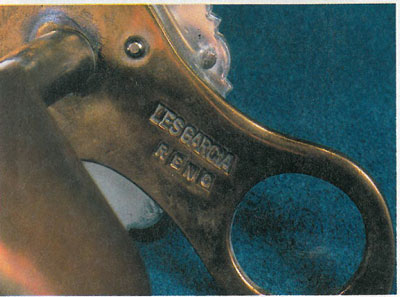
 This Visalia-style humane bit of magnesium-bronze with Salinas mouthpiece is stamped with the mark used by Les Garcia in Reno, Nev., between 1958 and 1978.J.M. Capriola’s is the only place where new Garcias are sold, so it is easy to be sure of the authenticity of a new bit or spurs. However, it is not so easy to verify the “origin of older pieces, which are by far the most sought-after.
Garcia pieces built prior to 1978 are generally divided into three distinct periods: G. S. Garcia, from 1896, when the shop began building bits and spurs in-house, to 1933; Salinas’ Garcia Saddlery, from 1945 to 1958; and Les Garcia, Reno, from 1960 to 1978. The hiatus between 1933 and 1945 was due to a shortage of materials caused by World War II.
Pieces from each era are distinguished by different maker’s marks stamped inside the bit or spurs. Those from the G. S. Garcia period bear a variety of marks in different sites, depending on the maker and the year made, but all are a variation on the basic “G. S. Garcia, Elko, Nev.” A few pieces bear an additional initial that represents the individual maker, although few of Garcia’s employees were allowed this privilege. Pieces bearing a backwards “N” are commonly believed to have been built between 1910 and 1920. Pieces from the Salinas period are marked with the words “Garcia Saddlery Co./ Salinas, Ca.” Les Garcia’s work sometimes bears the mark “Les Garcia/ Reno,” or simply “Garcia.” Current pieces bear the mark “Garcia/ Elko, Nev.,” along with a serial number. This numbering system has been in use since 1985.
Keep in mind, though, that any mark can be
easily duplicated with modern equipment, and also, according to Paula Wright, some older Garcia pieces are not marked.
Fraudulent makers have been known to age imitations artificially, rusting and rubbing them to simulate wear and use. Wright told of a pair of fake Garcias spotted on the Internet, which had well-worn heelbands inside, but brand-new, untarnished silver on the outside.
Another point: Although sterling or fine silver is used today, older bits and spurs were built using coin silver, a much harder metal. Taking into account the harder silver and the more primitive tools of the time, it is only natural that early pieces bear coarser and less detailed engraving than today’s work.
 Henry Garcia in Salinas used this mark on all bits and spurs made between 1935 and 1966.
Although these few pointers offer a little insight, they are just the tip of the iceberg. Much should be considered in seeking a collector’s piece. Research is priceless to any collector, no matter how experienced he may be. Wright emphasizes the importance of “doing your homework.” She strongly recommends Ned and Jody Martin’s book Bit and Spur Makers in the Vaquero Tradition as “a must-have for collectors.” (The book is available in a hard-bound, coffee-table edition or pocket-sized version from Capriola’s.)
Although Wright does not believe that true collector’s items would be available on the Internet, the Internet has opened up a new market for imitation Garcia sales. On-line auction sites allow anything with the word “Garcia” in the description to be displayed on screen with just the touch of a button. The name alone is well known, but most people surfing the Web in search of a collector’s piece lack the experience to discern the real thing.
Web descriptions often contain the words “marked Garcia, Elko, Nev” and, indeed, fake pieces are marked this way, but the wording leaves a loophole for the sellers should they be caught. However, Internet bidding may push the price up far beyond the actual value because people are afraid they will be outbid on a sought-after item, a situation frauds take advantage of.
A set of fraudulent bit and spurs might be offered for as little as $280. An individual piece, a true Garcia bit or set of spurs, will sell for at least that much. Wright compares the counterfeit bit market to the counterfeit money market. Just as the most frequently counterfeited bills are hundreds, the most frequently imitated bits and spurs are G.S. Garcia’s.
Wright also explains that the best place to obtain a true collector’s piece is a well-known collector’s auction, where the promoters and sellers are not only well educated about such things, but their reputations are at stake. Another source for a collector’s piece is the heirloom that’s been in the family for years but, unfortunately, families willing to part with their heirlooms are few and far between.
Above all, the Wrights want to increase awareness of fraud in the marketplace and offer their assistance to anyone wishing to research collector pieces, not only by Garcia, but also by other reputed makers. Everyone wants to believe they are getting a good deal on a piece of western heritage. More often than not, though, a little research reveals that the great deal isn’t so great. Shopping for a collector’s item is a lot like shopping for a car; it takes patience and research to ensure you don’t get stuck with a lemon.
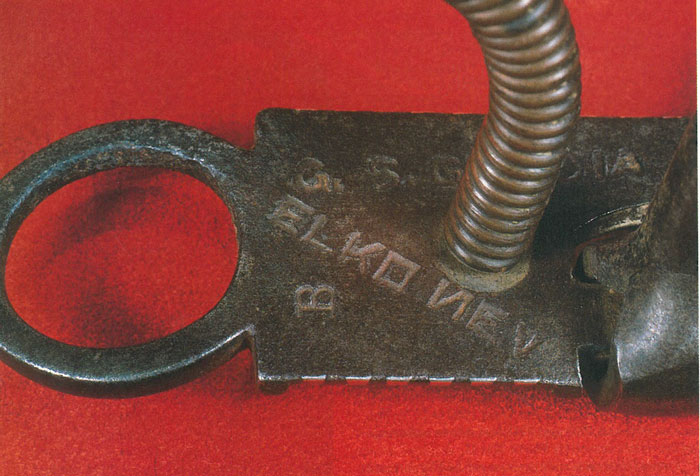 The backward “N” was used on pieces made prior to 1910. Occasionally G.S. Garcia allowed the individual maker to stamp his initial along with the Garcia mark.
Becky Prunty is part of the fourth generation on the family ranch north of Elko, Nev., where they raise cattle and horses. She graduated from the College of Southern Idaho with a degree in equine studies.
Not a subscriber? Click here to subscribe to Western Horseman magazine.







Howdy folks. In reading your article on identifying bits & spurs made by Garcia, I would like to share some information that may contradict a small part of this article.
I am an auctioneer in S. Oregon, over 40 years in the business. In your article you stated:
“Another source for a collector’s piece is the heirloom that’s been in the family for years but, unfortunately, families willing to part with their heirlooms are few and far between.”
Sadly, in ther past 10 years we have noticed a trend where the younger generation selling of a deceased parents things has no interest in very many “family heirlooms”… if the piece isn’t a direct connection to the parent, they don’t want the “stuff”, they just want the check. I find this to be a bit disheartening, but becoming more and more true, on the west coast anyway.
Thank you for your time and great reading.
Auctioneer Frank Dodge
Eagle Point, OR
Thank you for your feedback, Frank! You will notice that the article you’re referencing was published in our magazine in 2001. It is definitely sad to see the trends change.