
You’ve been around the world, spent time at sea, what made you settle on cowboys and the West, why not sea stories?
I did write some stories about that, in fact I intended to. But I had been born in North Dakota. Not in a really western community, but my father was a veterinarian who had a lot of business with ranchers and farmers around the country, and he’d also been a deputy sheriff up there. He used to have to check all the cattle shipments–he was a state veterinarian. And the cattle shipments
were all escorted by cowboys. So I knew quite a few of them.
Then I had two uncles, one of them had punched cows out in Montana for a while. The other one, oh, I’d give anything in the world to have him back he’s long gone now. I never knew him very well. I only saw him two or three times as a small boy. But I’d give anything in the world to have him around now, because he was a gold mine of information.
This was a man who had no particular desire to ever amount to anything or make any money. He just loved the West and he traveled all over from one end to the other. Once, up in Wyoming, he managed a ranch for an English gentleman who had a lot of money. He managed the ranch very successfully and the Englishman said, “Since I’ve had this ranch, this is the first time I’ve made any money from it. If you will stay on, I’ll give you a third of the ranch for yourself.” He (my uncle) quit the next day.
But he had gone through Death Valley when it was very, very raw and new; he’d been clear down in Sonora, way up in British Columbia–what a life this guy had! When he was managing a ranch up in Montana, Butch Cassidy and those boys used to ride across the back pastures on their way to the Hole in the Wall. He knew them all. They used to sometimes swap horses there. They would drop their horses, rope some of his, and ride them on. Usually the horses they left were better than the ones he had, so he never minded too much.
He used to come back home every once in a while with his wife and he would tell stories about what he had been doing. And I just hung on them.
That had a big influence, and my knocking around in the early days, meeting a lot of these guys, had a big influence, too.
 But what actually happened was strictly accidental.
I had written several western stories for pulp magazines, but I had also written a lot of air stories and sea stories and boxing stories and football stories.
The thing that really turned it was a story called “Gift of Cochise,” that sold to Collier’s magazine. Reader’s Digest reprinted it a couple of years ago. Anyway, I wrote that story and the editor from Fawcett Publishing Company, Dick Carroll at the time, called me, and said, “Look, I just read ‘Gift of Cochise’ and you’ve got a great story there, but those characters are too good to leave. Why don’t you make a novel out of it and I’ll buy it.” It was Hondo.
This was 1953 or ’54. I wrote Hondo then from those characters and John Wayne bought it (for the movie) and it sold over a million copies. So then everybody wanted westerns from me, and here I am.
How do you feel about what Hollywood and the television people have done with your stories?
How The West Was Won was quite well done–there were some places I would have retouched it a little bit–and I had several others that were, but by and large, I did not like what they did.
The difficulty often is that you get an eastern man, who has no knowledge of the West, and he tries to do a western the way you would an eastern, and it doesn’t work. The western man was a different caliber of man entirely. That’s the main trouble with the westerns that they’ve made lately is that they were made by people who don’t understand the West and have no real background in it, and consequently they don’t come off. They don’t quite make the grade.
I had a couple of movies done by an Englishman who had a good feeling for the West. Shalako just missed. They cast Bridgette Bardot as the girl in it, largely because she was a big draw. And she was wrong for it. Sean Connery did the lead very, very well.
Then there was the picture called Catlow, with Yul Brynner and Richard Crenna, which I enjoyed. Heller in Pink Tights, with Sophia Loren and Anthony Quinn–great cast, just missed. And it missed through no fault of anybody on the picture except the company. The company that was making it decided that they had spent enough money on it and they were going to stop right there.
What do you use for references on horses, saddles, stagecoaches, etc.?
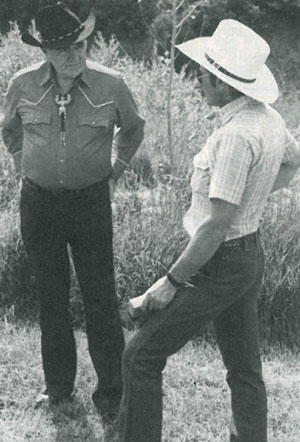 L’Amour and Vorhes at the ranch.A lot of it comes from knowledge I picked up while I was just knocking around. But also I have referred to a couple of books by Jo Mora, he’s very good. And an old friend of mine, Foster Harris, wrote a pretty good book on the look of the West.
I have references I go to. I have used your magazine a few times. I have collected quite a bit of material over the years, I have most of it in Los Angeles. I have quite a library of background materials.
In the early days of the West , you could just about tell where a man came from by the look of his rig.
Are you aware of the revival of the old buckaroo styles? What do you think of it?
Yes. I don’t know what to think of it, to tell you the truth. I just had a guest here in the house, Charlie Daniels, the country-western singer. He’s a good friend of mine. He wrote to me several years ago and asked if he could dedicate an album to me; he’d been reading my stories. And Charlie loves to rope and ride. So we were talking and he was bringing up this buckaroo business.
Its kind of interesting getting around the country. We visited on a ranch over in eastern Colorado and all the cowboys were wearing their pants tucked down in their boots and I hadn’t seen very much of that lately.
Not a subscriber? Click here to subscribe to Western Horseman.
I was a 9-year-old girl reading my dad’s Louis L’Amour paperbacks in secret under the covers until the early hours of the morning. Ah, the excitement. Often finished a book in a day.