Mention the name of Leo Moomaw to any old rodeo hand or long-time fan and that rodeo hand or fan will almost invariably bring up the name of the great old bucking horse, Badger Mountain.
In rodeo lore, Leo Moomaw — and Tim Bernard—and Badger Mountain are about as closely allied as Bob Crosby and his old black hat, Bill Pickett and bulldogging, Dick Stanley and Steamboat, and Clyde Burk and old Baldy.
Leo Moomaw and, later, the Moomaw and Bernard partnership owned many first rate bucking horses, but Badger Mountain was the one the cowboys and fans all talked about, the one the photographers always snapped, and newspaper and magazine writers all wrote about. In the decade preceding Pearl Harbor, Badger Mountain was rated one of the three top bucking horses in rodeo. The other two top horses of that period were Five Minutes to Midnight, owned by McCarty and Elliot, and Hell’s Angel, owned by the World’s Championship Rodeo Corporation.
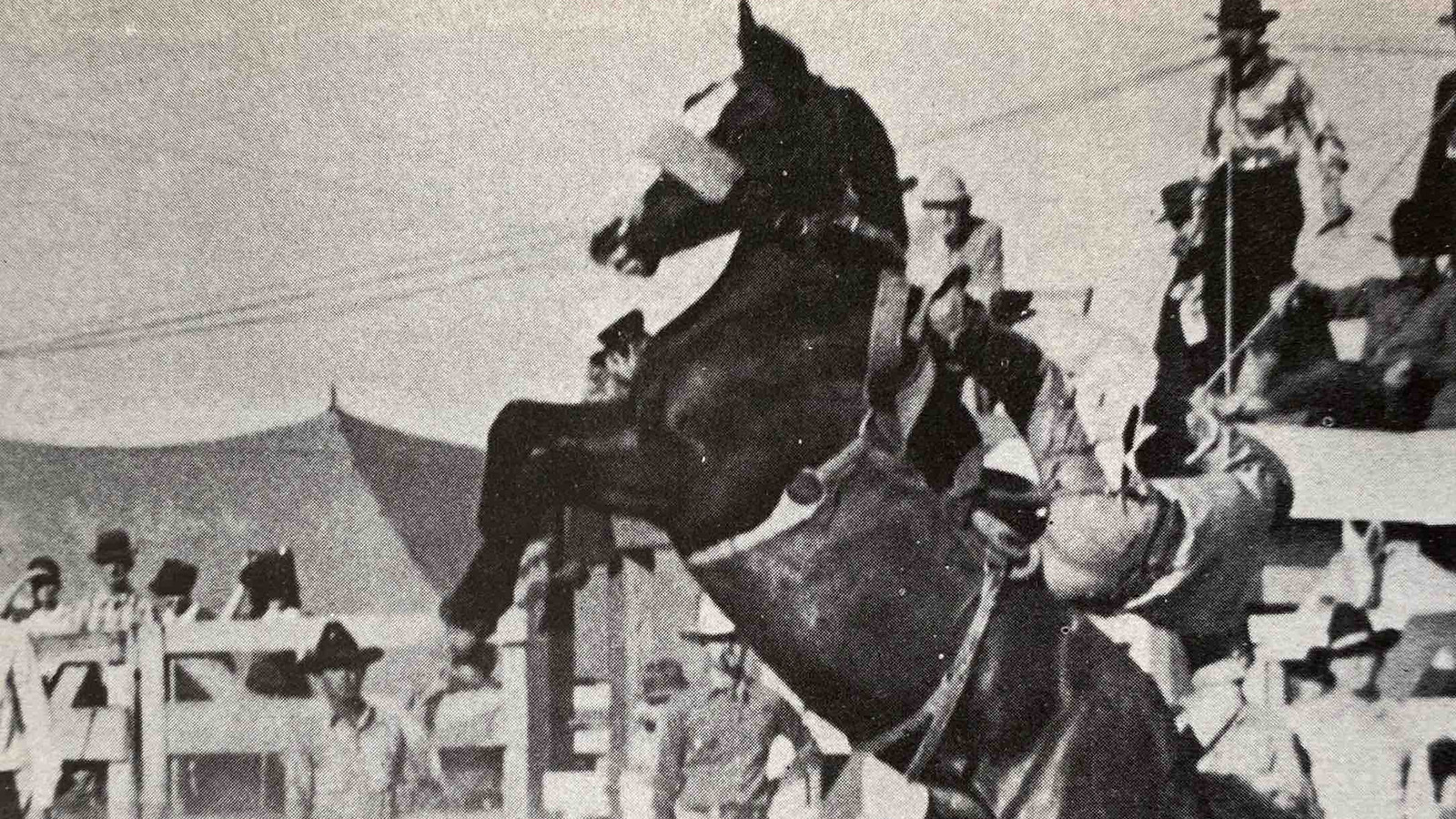
In his first three years in the arena, Badger Mountain bucked off everybody. None of the many cowboys who got on his rough old back was still aboard after six jumps. He was bucking then much like the rambunctious Snake did in later years. Then, at an Okanogan County rodeo, someone pulled a shenanigan and fouled the horse. The Badger never bucked the same way again—but, maybe, the new way the Badger bucked was the better way. Anyhow, from then on, he bucked in a manner that was to make him even more famous and in greater demand than before at rodeos all over the country.
On that fateful long-ago day, the Badger had been saddled early. At some time, a rock had been slipped under the cinch, just below the horse’s heart, and the cinch pulled tight and the horse left to stand. How long the Badger stood in this manner no one knows except the guilty party. Moomaw eventually got wind of the shenanigan, ran to the horse, pulled out a knife, and cut the cinch. As the cinch parted, the rock dropped to the ground. It appeared that Badger Mountain was suffering from a severe cramp.
Later, the horse was put back in a chute, saddled, and boarded by the slated rider, and the chute gates were swung open. The fouled horse, it seemed, could not buck as he had before, but he didn’t quit — instead, he improvised. Out of the chute he reared, where he had never reared before, rearing higher and higher and throwing his head back; then, he suddenly lunged forward, shaking himself like a wet dog, and the rider came tumbling down. The next time out, and all the times out after that, it was the same.

In the ensuing years, the eruptive rearing, plunge, and violent shimmy-shake unseated most of the top bronc riders of the 1930s and 1940s — riders like Deb Copenhaver, Jerry Ambler, Jackie Cooper, Bill Linderman, Cecil Henley, Turk Greenough, Burl Mulkey, Bob Burrows, Jack Wade, Bill Ward, Paul Gould, Cecil Bedfore, Vic Schwartz, Buck Tiffin, Ernie Mutch, Bev Connor, Jack Sherman, and Mose Kruger, among others.
Badger Mountain got ridden once in a while. Stub Bartlemay drew the horse seven times, and, it is said, he was bucked off four times and rode the Badger three times. Moomaw confirms that Stub Bartlemay rode Badger Mountain three times and says he believes that Nick Knight, Joe Kelsey, and Don Happy also chalked up rides on the Badger’s rough old back, along with a few other cowboys on the way. Moomaw, a cowboy from way back and veteran stock contractor-producer, has probably forgotten more than many of us will ever know about rodeo. He started as a contestant shortly before World War I. He was an all-around hand, a bronc rider, ‘dogger, and roper. Moomaw ranched in those years, too, as he does now, raising a few cattle and a lot of good horses. One year, a local group was putting on a rodeo in Davenport, Wash., and paid Moomaw $75 to supply a rough string of horses for the event. Moomaw and some of the other boys rounded up a bunch of wild ones and trailed them 150 miles from the home ranch to Davenport. A chuckwagon, loaded with grub and bedrolls, was taken along; and they camped out every night, holding the wild horse herd.
At one time, Moomaw owned a canvas arena-fence that was 8-feet high and some 350-feet long. This contraption would often be rigged to post set up in front of bleacher seats and a rodeo would be run off in this portable arena. How did those early contests turn out financially? Moomaw claims, “Sometimes we would end up with money in the pocket of our jeans! Other times, some scallywag would go south with the gate receipts.”
Win or lose, Moomaw loved rodeo and still does — and he is still in the stock contracting-producing end of the cowboy sport.
In 1933, Moomaw had his rough string in Waterville, Wash., for a rodeo. There was a horse on a ranch nearby which had quite a local rep as a bucker. Moomaw was interested. The day before the start of the Waterville rodeo, he and three rodeo hands — Henry Michel, Bert Evans, and Billy Corneil — drove out to the ranch. The horse they had come to see was a bald-faced bay called Badger Mountain. This horse, then 6- or 7-years-old, had originally been owned by a Douglas rancher, familiarly known as “Old Man” Badger. As a chunky, green colt, Badger Mountain had been sold by Badger to the Willms brothers, who had a ranch out of Waterville. The Willms brothers tried to make a saddle horse out of the colt, but they couldn’t ride him, nor could anyone else around. Then they decided to make a plow horse out of the colt, but, again, the lively colt wouldn’t cooperate. Next, Moomaw and the three cowboys arrived on the ranch. The Willms brothers wanted a good work horse; Moomaw was always interested in a good bucking horse.
Badger Mountain was taken to the Waterville rodeo grounds and put into a chute. Henry Michel, who had won the northwest saddle bronc riding event at Pendleton in 1930, put his committee rig on the haltered horse, found the stirrups, and took his rein. Moomaw opened the gate and the horse bounced into the arena. Michel was only aboard for four fast jumps. Moomaw was convinced and a horse trade was made with the Willms brothers.

Badger Mountain’s name was in the rodeo draw that night for the first time, and, of all things, Henry Michel was the rider who drew the Badger. This time, however Michel lasted five jumps. Moomaw later turned down a $1,000 offer for Badger Mountain. The Willms Brothers, rated as pretty good horsetraders themselves, never did get over the way this Badger Mountain horse-trade turned out.
In 1934, Leo Moomaw and Tim Bernard teamed up as a rodeo stock contractors-producers. In addition to breaking horses, which had been Moomaw’s specialty, the partnership furnished Brahma calves, bulls, c
ows, and ‘dogging steers to rodeos. All went well and Moomaw and Bernard, and Badger Mountains, too, became very well known and very highly regarded figures in the big-time rodeo picture.
Along with Badger Mountain, Moomaw and Bernard had many other outstanding buckers which were regularly putting the cowboys down, or into the money. One of these buckers was the great Blue Blazes. Moomaw says, “I can’t understand why Badger Mountain was rated so much higher than Blue Blazes. Old Blue Bucked off a lot of champions, few boys ever did ride him; yet, he was, and is now, hardly ever mentioned.”
This blue roan bronc was out of a Moomaw string bucking-mare, named Maude. Maude, in her day, was also quite a bucker. They had another top mare in the string then, too, called Shake ‘Em Down Sally, which really shook down the cowboys. But, in her prime, this energetic mare was killed in a highway accident while enroute to an Ellensburg rodeo. In that same truck load of bucking stock were Badger Mountain, Blue Blazes, WidowMaker, Jack Wade, and Swift Current, all noted broncs. All survived the accident except Shake ‘Em Down Sally.
In 1946, Moomaw and Bernard sold their stock to the Ring Brothers, and were out of rodeo. Moomaw and his sons were, and yet are, ranching together out of Omak, Washington. They own some 2,000-acres and also have added some open range rights. They run cattle and horses and raise some hay and grain. Through the years, Moomaw has produced, in addition to the broncs, a number of good running horses and using horses of the ranch and rodeo variety. Moomaw’s horse Ted, now 18- or 19-years-old, is still a good ‘dogging mount. Years ago, Moomaw and Bernard bough a Red Buck stud colt from King Merritt. Moomaw also had a Quarter Horse type, registered Kentucky Thoroughbred stud horse. At one time, too, he had 40 sorrel mares; their colts and fillies were really a sight to see.

In 1953, Moomaw was back in rodeo, teaming up with stock contractor Joe Kelsey. In the old days, young Joe Kelsey — a sharp bronc rider — had been a pick-up man at Moomaw and Bernard rodeos. Moomaw says, “I often see pictures of our horses — the Kelsey and Moomaw string — in The Western Horseman.”
As to Badger Mountain, he was used for exhibition rides in his later years and not in regular competition. His last appearance in the arena was at the Omak Stampede. After that stampede, the old bronc was retired to Tim Bernard’s ranch out of Loomis; there to live out the rest of his life. One day in March, 1954, Bernard decided to check over the old horse. Badger Mountain was put into a chute for examining. In the chute, the old bronc got excited, threw up his head, started to move about, and then dropped dead. The cause of death was diagnosed as a heart attack. The horse was then approximately 30 years old. Now Badger Mountain sleeps the long sleep on a high knoll overlooking the Bernard Ranch and the surrounding countryside.
This article was originally published in the January 1960 issue of Western Horseman.
Very interesting article, an acquaintance of mine who now resides in idaho has a picture of Badger Mountain on the wall in his saddle shop. He says a gent in the background is his uncle. This gentleman
is from Omak Washington.