
Against the elements, pile-driving buckers, rough range country and wild cow cattle, courage was an earmark of the cowboy’s trade.
 Spring roundup on the old San Marcus Ranch in 1905, with several pairs of ropers at work.
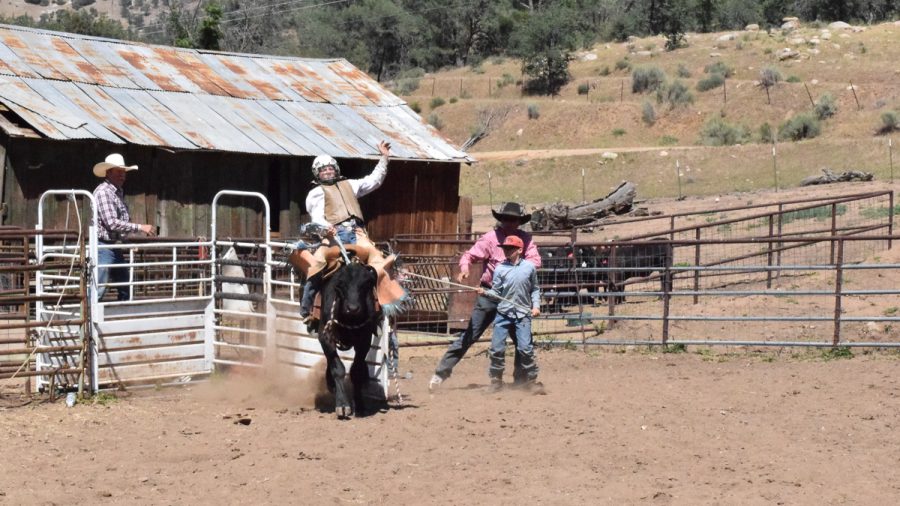
Courage was an earmark of the cowboy’s trade. Many suddenly lost their riding nerve after suffering a serious injury or after seeing a close friend kicked all over the ground when his foot caught in the stirrup and he was dragged and kicked to death: If he was an exceptionally good rough rider often the terrific beating from bucking would shake loose a kidney or injure the liver or cause some other personal injury and put him out for all time. The most common injury is the hernia, which is a “gift” from riding hard fast, pile-driving buckers.
Once a rider has quit riding this type of horse, whether through injury or loss of nerve, he will continue to ride gentle ones. Much as he regrets the humiliation of having to give up forking anything on four hoofs he continues to ride the less tough ones, as plenty of courage is needed in the cow game besides riding the back of a bucker.
The cowboy, by nature of his trade, is from time to time required to fight the elements. In the southern part of the country he has the hot deserts and in other parts the night and day vigils in the cold rain and sometimes in snow, being wet or damp most of the time. When on roundup and the wet season caught up’ with the crew the puncher slept on the wet ground and rode in a wet saddle in slippery country on young horses that were ready to break in two if the opportunity came their way.
Swimming rivers or running in country where the ground was pitted with gopher, ground squirrel, or badger holes was all part of his work. All the time he faced the chance of having to take a fall that might kill or cripple him for life, and most of the time he rode alone. Rarely would he complain for he figured that by complaining he might as well quit and he was no quitter.
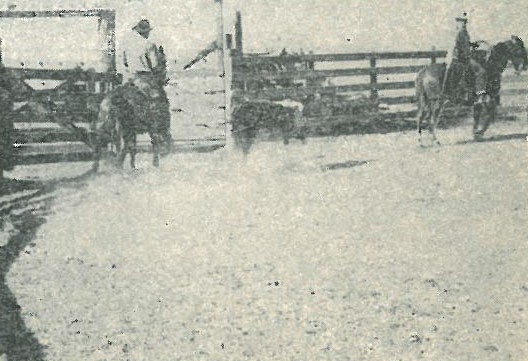 Steer leading out. In the earlier days when the rawhide reata was extensively used it was made of heavy stock and usually ranged in length from 45 to 70 feet. Although the long rope has often been a topic of discussion, consideration must be made regarding the kind of cattle and the country that had to be contended with when the working season was on. Wild cattle are handled much differently than gentle-raised. When “wild” is mentioned it does not describe a few head of stock running down to a water hole or coming into the wooded area for protection from the hot sun or from cold winter winds, rain or snow. Wild cattle look, act, and live differently. They never have been branded and are what we call orejanos. They never saw the inside of a corral and in most cases their first acquaintance with one was when they had been roped and led in off the range.
It is a pretty sight to see a large bunch of this type running down a slope to go into hiding. How gracefully they will jump over a large clump of chaparral or sagebrush or rocks and never touch any part of it with their feet! Cattle of this caliber will take away gentle ones with them so each season it was customary on big spreads to try and clean out as many as could be caught by roping them. Some ranches paid each cowboy $2.50 to $5.00 a head for each one caught. This was in addition to his regular wages.
Out here on the coast and in Nevada and eastern Oregon the long reata was used for such roping. It also required a fast horse that was sure-footed and had plenty of power. Running after one of these critters required a good roper as the rider had to throw a large loop at a distance of 40 to 50 feet to make a catch around the horns or a front foot. He couldn’t sneak up on him and drop a loop over his head. The rider of thirty or more years ago sat deep in his saddle, rode with long stirrups and sat up straight–not slumped over as you see so many today.
He kept his legs straight and close to the body of the horse, ready for any unexpected move that might come, especially if he was riding a horse that would scare at anything, even his own shadow. Any old buckaroo who has followed this kind of riding in rough country knows that here again it takes courage or as the old saying goes, “plenty of guts and a good horse.” Cattle like this are not being caught napping on flat country and the roping of them is mostly done on uneven country at a good clip. Here the buckaroo used his skill m handling his horse, rope and critter all at the same time.
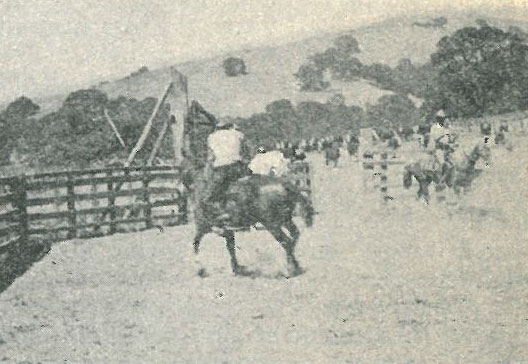 Leaning away from the pulling critter.The rider helped his horse by throwing his weight, usually on the side he gets on, so as to help balance him because when running down hill often a big rock or other obstacle gets in the way and the rider will feed out rope and give his horse a chance to clear it. While this is going on, if a moment comes when the critter should give a sudden jerk on the rope the rider’s horse can easily be thrown down if caught off balance. This kind of riding and roping was not practiced by the tie-hard and fast method because in rough timber country it is too dangerous.
In roping heavy stock as it was done years ago whether in the corral or on level country, the rider always helped his horse at every opportunity he had. This is still done in many cattle areas. The river, by throwing his weight to the opposite side from which the animal is roped, helps his horse by easing the jerk in much the same way as is done by letting the reata run around the horn of the saddle enough to break the jerk when the animal comes to the end. Failure to help the horse in this way often causes sore withers and ring and kidney sores. It is regrettable that today so many young riders are not being taught the fundamentals of how to sit in the saddle and carry the body with the movement of the horse. To anyone who has never seen this kind of work it is almost impossible to give them a word picture, but those who have had a part in this type of cowboy life know what it’s all about.
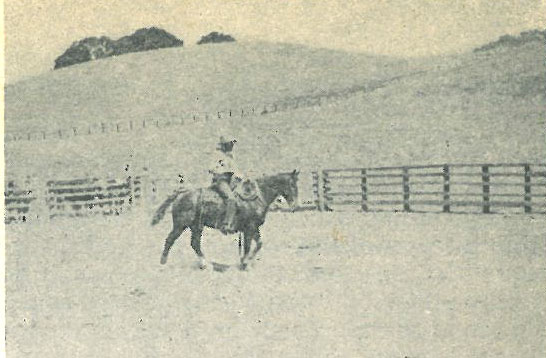 Riding up slowly to bunch with loop over shoulder.Big corrals, as shown in the pictures accompanying this article, were common and several pairs of ropers were working at one time using three or more branding fires. It was not necessary to run stock to make a fancy catch as they had enough spunk of their own. They were nervous and high strung and the problem was to quiet them down before starting to work on them. In most of the roundups it was a common sight throughout the day to see some critter try to clear the corrals. Occasionally one would make it and land running. Corrals were around 61/2 to 7 feet high and some may wonder at this height. When you have spent many years riding range country where you come into contact with this kind of stock a rider will not be astounded, but he will marvel at the gracefulness and ease with which a steer will go over.
I have seen steers with long rangy legs, built like race horses, clear the railroad stock corrals. Oftentimes when a bunch of this kind of stock was caught and left overnight in one of these corrals with a few gentle head of cattle it was not uncommon to find some gone the next morning. We buckaroos used to have a lot of fun with the tenderfoots, accusing them of turning the stock out. Some of these little buckaroos who had worked on one-man outfits and had never had any experience with this kind of cattle would be taught the hard way. Time after time we would send out two or three of these fellows to hunt up the cattle and bring them back in, knowing of course that they didn’t know the first principle about where to hunt for them, how to track them down or hunt them out.
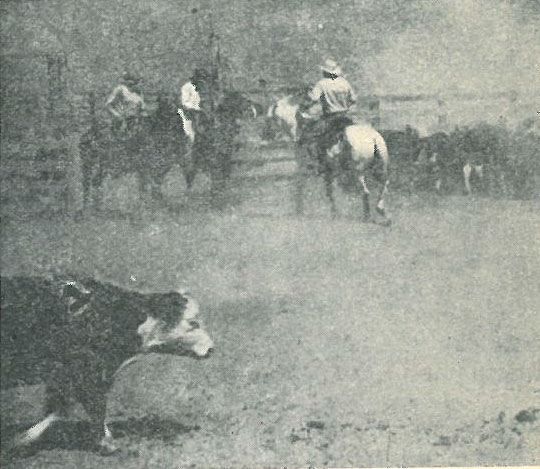 Breaking out from the bunch.Working in the corral required as much skill as out in the open rodeo. In corral work when the stock would settle down the roper would ride up slowly to the bunch and let one break out and lay the loop on him. The riders always played their animal toward the fire so they wouldn’t have to drag him. When the critter leads the way the rider that is heeling for his partner had his loop always ready and hanging from his shoulder. The rider that is roping by the neck will keep his rope short which gives his partner a better chance to make his catch of both hind feet. It was a common thing to bet between pairs of ropers who could catch the most in a certain specified time as well as make pretty catches. They would call their throws, such as both front or hind feet, either with an under or overhand throw, backhand, straight, etc.
You never saw them get tangled up in each other’s ropes. The buckaroos weren’t jerking their horses, whipping them or spurring them or doing any unnecessary running. If a rider had the urge to do a little running or racing, or if his horse was a little tired and he was beginning to push him along too much, the buckaroo boss would store all this in his mind and change that rider’s line of work. There was plenty of rough stuff to catch on the range, rough horses to ride, and rough range to run on; so usually some fine morning a buckaroo would be headed out with another partner, with orders not to come back empty handed. The better care you took of your horse, the easier you did your work; the more consideration you gave to the cattle, as well as your horse, the more the foreman thought of you.