Blogs / Culture

From the Lens With Kate Bradley Byars

Mare and foal walkign through the field

Join Western Horseman contributor Kate Bradley Byars on a story-gathering trip to Montana and South Dakota.

Connections to the ranchers, horsemen and women featured in Western Horseman are made on trips that take writers and photographers far from their desks and into the thick of the branding smoke. For five days, I traveled 1,065 miles from Rapid City, South Dakota, to Colony, Wyoming, to Broadus, Montana, and back again to the Rapid City area, gathering story content. Trips like this one are how Western Horseman brings authentic stories and photographs of the Western life to readers, and it is also the way we connect with our subjects.

In 2011, with then-publisher Darrell Dodds, I made my first foray into the South Dakota horse industry, writing about the iconic Myers Performance Horses and the chap maker Jack Gully. The big-boned, athletic horses were eye candy to this Texan, and ever since then, I’ve loved including stories about the wonderful bloodlines, breeders, ranchers and horse owners in that area. Jack helped me connect with those ranchers, inviting me to brandings, like the one on the Powder River breaks at the Mckabben Ranch this year. 

This year, I ventured back for my seventh trip to the Mount Rushmore State with a few goals in mind: one, to gather content for two upcoming print stories, and two, to show my fellow freelance writers Abigail Boatwright and the former Western Horseman Senior Editor Jennifer Denison the great people and horses of the area. Abigail connected with a couple of sources I met on previous trips, and she gathered content for some upcoming Barrel Horse News articles, Western Horseman’s sister publication.

“Traveling to a new area to see the horses, ranches and people in this Western industry gives me a new appreciation for the jobs we do with our horses,” Abigail says. “The branding in Montana was reminiscent of the Western performance horse world, sorting cattle and working in ways horses have evolved to do in the show arena. Seeing them at work in Montana, Wyoming and South Dakota, with the backdrops of the Powder River breaks and the Black Hills or Badlands, was a thrill.”

Take a visual trek through our five-day trip that spanned three states, visiting three ranches, two longstanding breeding programs and a wealth of wonderful people. Here is a behind-the-scenes look at the authentic Western stories printed monthly in your magazine.

The Dacar family’s Muleshoe Ranch was the perfect spot for us to stay in between shoots and to say hello to a family that Western Horseman featured in 2021. Plus, the opportunity to shoot their working dogs couldn’t be missed. “Ruth,” a 15-month-old border collie, showed us her skills.
Ruth and “Rip,” an older male, gathered and moved the yearlings swiftly across two pastures, nearly leaving Levi Dacar in the dust. The herd and dogs crossed the Belle Fourche River three times.
To move cattle, Levi Dacar was mounted on Pay The Hitchhiker, a gelding sired by Irish Pay, and the subject of another stop on our trip.
The alarm came early on branding day, leaving Wyoming at 3:30 a.m. bound for the Mckabben Ranch, 39 miles southwest of Broadus, Montana, along a dirt road that paralleled the Powder River. Once, there, Abigail (pictured) and I caught the herd with the help of horses loaned to us by Jack Gully, of Newell, South Dakota.
Ranching and the horse industry are close in South Dakota. Jack rides a Paint bred by Fischer Farms, of Wagner, South Dakota, and a breeding operation that Western Horseman featured in 2024.
Ronnie Mackabben surveys the 300-head herd brought in to the portable branding pens. The Mackabbens have ranched this land for 20-plus years and focus on holistic practices.
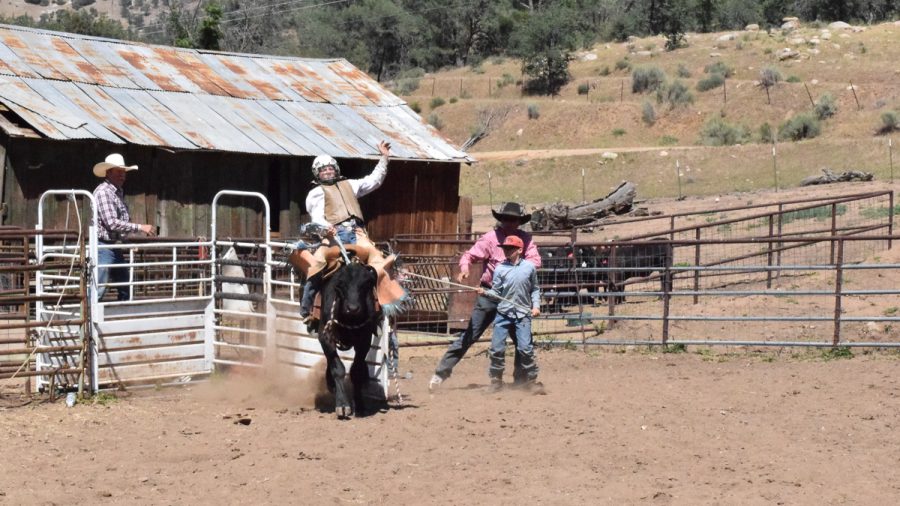
Several young riders and calf muggers worked the Mackabben branding, learning the ropes for coming years.
The Mackabbens’ run three irons on each brand, an “M,” a “5” and a bar underneath.
The golden hour descended on Newell, South Dakota, for Kelly Gully’s shoot. Selecting a horse to accompany her portrait was easy: the mare that carried her miles gathering cattle and to the American Quarter Horse Association Select World Championship Show World Champion title, Sailors Luv Freckles, called “Speck.”
The final stop was catching up to Jack Dye, outside of Hermosa, South Dakota, as he and his crew gathered, doctored and shipped his Angus cattle north from the flat pastures up into the Black Hills, near Custer, South Dakota, for summer pasture. In an ironic, but not surprising, coincidence, he was riding an Irish Pay mare.

1 thought on “From the Lens With Kate Bradley Byars”

Leave a Comment

Recommended