


exciting experience. Yet without honest assessments of your skill and commitment, it can become frustrating, expensive and dangerous.
LIKE A PILOT WHO SPENDS TIME inspecting his aircraft before taking off, I want to know my colt is prepared both mentally and physically before I get on. If a pilot flies the same plane every day, his checklist might take only a few minutes. If he hasn’t flown in awhile, he might spend an hour running through his checklist. It’s the same way with my colts. If I’ve been riding them daily and have built a certain amount of predictability, I might spend just a few moments on the ground, tighten my cinch and get on.
But, if this colt has had some time off, I might saddle him up, go to the round pen and send him around the pen at the walk, trot and lope, watching him go through the full range of motion in both directions. Only when he’s traveling relaxed and making smooth transitions through all three gaits will I consider getting on. He might be sweaty by the end of the session, or he might not. What’s important is that I’ve warmed him up, helped him relax, and have him in a receptive frame of mind before I climb aboard.
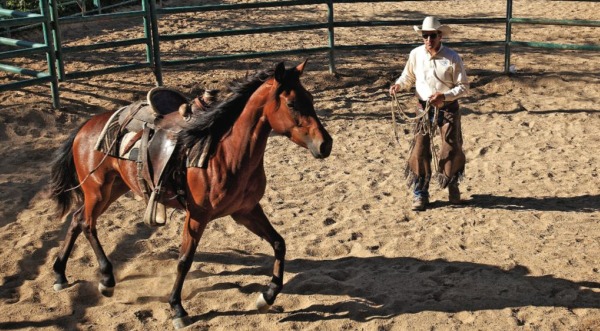
A COMMON MISTAKE made by the backyard colt starter is that he fails to get his colt moving though all three gaits soon enough. Generally it’s because he’s scared of what might happen. I’m just the opposite; I’m scared of not having my colts moving out early on. If I only spend time walking and jogging my colt, the day when he spooks and takes a loping stride will be a big surprise. He didn’t know that loping with a saddle and rider was part of the deal, and now I’m bucked off. I need my colts moving out in the full range of motion during the first couple rides, and on every ride that follows. The longer you stay away from it, the bigger deal it will be.
Another mistake of the novice colt starter is overdirecting and micromanaging the first few rides. When I first ask my colt to move out, I don’t care where he goes, I just need him to go. Forward impulsion is my main objective at first. Pulling and tugging on the reins only hinders that.
The round pen is a great tool and a relatively safe place to get started, but I try to get out of that pen as soon as I’m confident my horse and I can survive the experience. Forward impulsion will come much easier once I leave the confines of my 50-foot pen and venture into a large arena, around the barnyard, and then to the trail. Your colt will probably be unsure, so allowing your colt to follow someone on a broke horse can make a big difference in these first few rides beyond the round pen.
When I give my colt something productive to do, he doesn’t have time to be unproductive. Perhaps this means riding him down a lane or around the barn, or asking him to look where his feet are as he walks along a rocky trail.

IF I WANT MORE than just a mediocre trail horse, and truly desire more performance, I need my colt to achieve flexion and softness in the face. Often this is called a “soft feel,” “on the bit” or “driving up into the bridle.” Whatever the wording, I expect my colt to give his face and bend at the poll when I pick up on the reins. If my colt isn’t soft, it doesn’t make any difference if he can slide, spin or make flying lead changes. If he’s resistant in my hands, I’m not going to like the maneuver.
It’s important that I don’t try to achieve softness by only using my hands. Collection is a combination of vertical flexion and impulsion. My legs can be a tremendous aid in developing a soft feel and collection. As I bump with my calves in a rhythmic motion, I hold my horse’s face with my hands, causing him to pick up his back. If I move forward, this creates drive from the hind end to the front, producing a more collected and athletic frame, and a posture he’ll need to perform at higher levels.
However, this all has to begin at slower speeds with positive results before I step things up. Young horses get frustrated when they attempt to yield and soften without reward. If I don’t reward his effort by releasing, he’ll begin to brace and pull against my hands. When my colt gives, I give back. In time, I can reasonably ask my colt to hold this feel for longer periods.
Horsemanship is a lifelong journey. Softness and willingness are things you can’t buy at the tack shop. They come only as you invest in yourself.