
For decades, cowboys have lived by an unwritten code of ethics that guides how they work, and how they interact with and treat livestock, their horses and other cowboys. Much of it stems from respect, common courtesy and an understanding of how to get the job done. Below are a few important, time-honored codes.
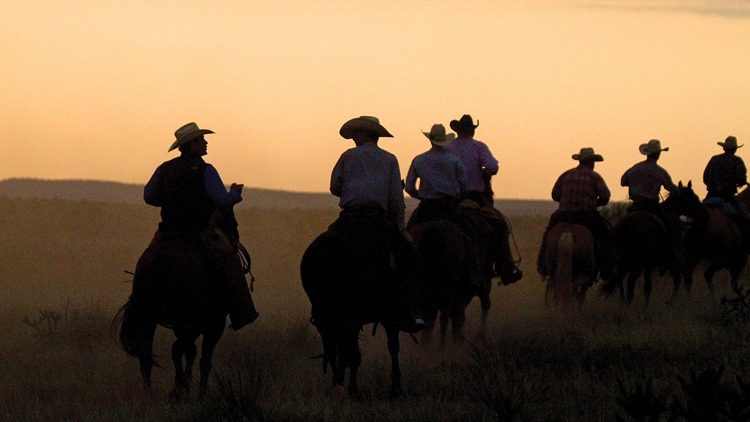
RIDE BEHIND THE BOSS
When a crew travels anywhere ahorseback, experienced cowboys know that the boss always leads the way. It’s impolite to ride in front of him, and besides, he knows the country and the strategy for the day’s work.

STAY IN YOUR SPOT
When moving a herd of cattle, it’s important to stay in your position. If you’re bringing up the drags, continue driving from that spot. If you’re flanking the herd on the right side, don’t move somewhere else. Jim Scott, who ranches in eastern Montana, says that staying in your spot makes trailing cattle work smoother, shows respect for the other cowboys and helps everyone know their responsibilities.
“If you move, it’s not only a lack of courtesy, it’s a lack of teamwork,” Scott says.

PERMISSION TO SADDLE UP
If a person is visiting a ranch without a mount or a hired hand’s ride is temporarily out of commission, it’s impolite to saddle up someone else’s horse without asking. Nebraska rancher Craig Haythorn strictly adheres to this code, even though he and his family own all the horses the cowboys ride.
“If I know of somebody that needs to borrow a horse, I don’t loan one away without checking with the guy who has that horse in his string,” Haythorn says. “The horses are mine anyway, but it’s customary to ask.”

DON’T MAKE COOKIE MAD
Even dogs understand not to bite the hand that feeds them. Likewise, cowboys are careful to stay on Cookie’s good side while he’s chopping, mixing and serving their meals. Many hired cooks work from before sunup until after sundown preparing three meals a day to hungry cowboys. Cowboys who fully understand this code are sure to compliment the cook on the food and bring their empty plates to the sink.
ORDER THROUGH THE GATE
Whenever a group of cowboys rides up to a gate, there is an unwritten rule on how they pass through it. Generally, one of the younger men opens the gate, holding it for the others. To be courteous, the other cowboys go through in order, one at a time.
“It’s kind of the law of the land,” says Four Sixes cowboy Boots O’Neal, who has been punching cows for more than 60 years. “They all go through in order, then stop and wait on the man to close the gate. It’s a courtesy, more or less.”
HANDS OFF
“Thou shalt not steal” was written in stone—literally—thousands of years ago. Cowboys tend to honor this biblical principle with conviction. And for them, it goes beyond rustling calves, swiping the boss’s money belt or liberating a man of his prized saddle. Borrowing someone else’s belongings or riding their horse without permission is also not allowed. Even invading their space is generally viewed as a form of larceny.
“On ranches where I’ve worked, nobody used your stuff,” says Roland Moore, a veteran Montana cowboy. “Your stall in the stable was always yours. The cookhouse was a safe place, so much that you could leave your money on the table and it would be there days later. And at dinner, your spot at the table always belonged to you. That’s just the way it was.”

TAKE CARE OF YOUR HORSE
Taking care of one’s horse is a core principle of horsemanship. For cowboys, it’s a code that reaches beyond feeding, doctoring, deworming, grooming and patting their pony on the neck. Hay, grain and water come before beans, biscuits and coffee. Tired horses get to rest for days, sometimes weeks. Patient hands work light on the bit. During long, hard days working cattle, cowboys pause near water so their horses can drink. They also don’t mind taking a break, loosening the cinch, and even pulling the saddle off their partner’s sweaty back. A horse remains a vital tool on today’s working ranches. Not only does treating a horse properly shape a willing, loyal attitude, but it also sits well with a cowboy’s conscience.
A good article. And in my opinion the most import part is “Much of it stems from respect, common courtesy and an understanding of how to get the job done.” Those values are not inherent and must be taught by the more experienced and learned by the hand. I guess there are so many versions of the cowboy codes because they were “unwritten.”
Many people will say Zane Grey was the first to codify the code in his book “Code of the West.” Obviously most people have never read that book because he didn’t codify any code in it. A good story though.
Many codes are now just being made up, especially since we rarely drive cattle these days except to different grazing areas. Never ride in front of the boss is the one in this list I find almost impossible to follow. Most can’t tell me what that means. The boss is often going to the hot spots (trouble areas) and constantly moving. We rarely ride our horses into town for a drink.
In my opinion J.P. Owen has done the best job of codifying the code in his book Cowboy Ethics: What Wall Street Can Learn From The Code Of The West (2005). In that book he introduces the foundational “Ten Principles to Live By” derived from the unwritten code of pioneers and cowboys. He also wrote Cowboy Values: Recapturing What America Once Stood For (2008), which expands on the cultural and moral significance of the Cowboy Way, emphasizing honesty, loyalty, and integrity as timeless American values. I have found those books most helpful in understanding “the code.”
Otherwise, it appears that many “code elements” seem to be like gun range or poker rules. Each range (or outfit) has its own specific rules. Be aware, if you are new to an outfit. Watch for the furrowed brow. (The one your parents used to give.) That brow speaks volumes and is keeping with the ethic: “Speak less, say more.” Follow and watch others, be humble, and remember if someone is telling you something, it is probably for your own good or the welfare of your crew.
Most hands are willing to help you if you listen, because you are there to get a job done and they need the help…if you are helpful.
what a wonderful fore filling way of life. may God bless the Cowboy and his horse! i was always wanting this way of life. born too late and in the wrong state kept me from it. but inside, this is who i am. God Bless you all.
I’m in the UK, I think that the cowboy code is even more important in theses times, if more people lived there lives by this, the world would be a much better place.
God bless all the cowboys and girls for keeping this standard in there heads and hart’s.