


This story on a 1998 Ray Hunt clinic originally appeared in the November 1998 issue of Western Horseman.
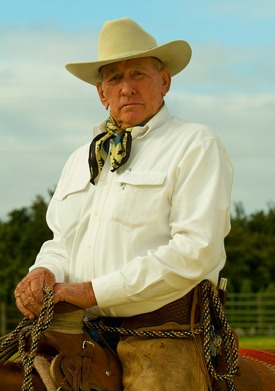
He’s called a master horseman, and his followers come in droves to hear him share the wisdom it’s taken a lifetime to put into words. His message is direct and his style can intimidate, but he makes one thing crystal clear: He cares about your horse and wants you to do the same.
Over the last three decades, Ray Hunt has built his reputation at horsemanship clinics across North America, Australia and Europe, delivering to his students a no-nonsense message about respect for their horses.
“People have to learn that whatever the horse does is right,” he says. “You’re the one who got into his life. He didn’t get into yours. It’s amazing what horse will go through to satisfy a human being.”
At Hunt’s colt-starting clinics, students bring green colts they’re starting under saddle. Each pupil is led through the process of familiarizing his horse with a saddle blanket, saddle and a handler’s actions, all of which seem foreign, even frightening, to some young horses.
In two days’ time, Hunt’s students will be horseback. Along the way, they’ll learn a lesson that goes unlearned in the lives of many horsemen: The animal must come first.
Ray’s Disclaimer
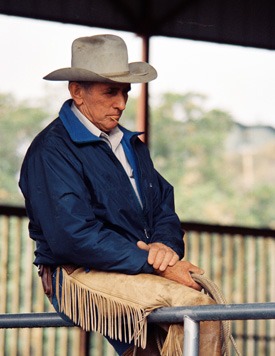
It’s an early summer morning in Colorado, and a few dozen people are beginning to congregate near a round pen at a suburban stable. A few minutes before the scheduled start of the clinic, 69-year-old Ray Hunt leads a saddled gray horse past the group of spectators and into the pen. He wears a work shirt, a hat that nearly matches his horse’s color, and weathered chaps over Levis, creating the unassuming visual of a seasoned cowhand. His presence, though, is larger than life as he shuts the gate behind him.
Turning slowly to meet each person’s eyes, Hunt begins his version of theater-in-the-round by letting his pupils know where they stand.
“I’m not afraid to call a spade a spade,” he says in a deep voice that booms and echoes over a PA system. “If I see something not working right, I’ll tell you. I’m here for the horse, not you, and I’m not here to win a popularity contest. If you like me when it’s done, fine.”
With that, the lesson begins.
Philosophy
Hunt was raised on a farm outside Mountain Home, Idaho, where he still lives with his wife, Carolyn. During his childhood, workhorses were a part of the daily routine. Young Ray formed an early appreciation for the animals and what it took to work successfully with them.
“My father used to tell me that if a horse will mind you in the barn, he’ll mind you in the field,” Hunt recalls. “I was brought up with a lot of discipline, and that carries over into what I do with horses.”
Respect forms the foundation of Hunt’s work with horses – gaining the horse’s respect, and respecting the horse.
“No one respects a horse more than me,” he says. “A horse thinks, feels, makes decisions. You have to put yourself in that horse’s place. You’d hope that he’d help you. Treat him like a friend, not a slave.
“People don’t try to do the wrong things with their horses. They do things the wrong way because they don’t know any better. Well, I’ve done all the wrong things anybody can do. You don’t need to.”
Hunt pauses in his introductory remarks and steps closer to his horse’s head. As he gestures toward the horse, he says, “This is my body, my mind.” He pauses again, taking a quick look in the horse’s eye before turning again to face his students. “Maybe not yet,” he says, “but one day.”
Lesson One
His introduction finished, Hunt mounts the gray horse and directs three of his students to lead their horses into the round pen. Each colt wears a rope halter, and their handlers carry saddles and blankets.
As they enter the pen, the students stand their saddles on the ground, then select open spots along the fence. Each handler keeps his horse’s halter rope draped over an arm, adhering to one of Hunt’s rules for working with green horses. “It’s a bad habit to drop your halter rope,” he says. “You’re just asking your horse to run off.”
Carrying saddle blankets, the students carefully approach their colts. As the young horses circle away from the blankets, Hunt coaches the handlers to move with their horses, teaching them that moving away isn’t an escape.
Soon, the colts are more comfortable and begin to stand quietly, but tentatively. The students carefully rub the blankets against the horses’ necks, sides, backs and hips. Before long, each colt tolerates the casual toss of a blanket onto his back.
Next come the saddles. Hunt watches as his students carefully place their saddles on the horses’ backs. They reposition the rigs, shifting them forward, back, side to side, helping build the colts’ comfort levels.
Finally, the cinches are drawn up and Hunt asks the handlers to leave the round pen. Still horseback, he rides to the center of the pen, waving a small red flag. He drives the colts around the perimeter of the corral, watching them closely and waiting for them to turn inward, to focus their attention toward the middle of the pen.
As Hunt circles the colts in each direction, the motion of a stirrup triggers the occasional buck from a young horse, sending the trio into a short frenzy. Once the group settles, and the colts seem comfortable and readily direct their attention to Hunt, the handlers return to halter them. The colts are taken to a larger round pen, 150 feet across, where they’re turned loose, still saddled. Another group of three is brought into the pen with Hunt, and the process begins again.
By afternoon, several sets of colts have been turned loose in the larger round pen. Hunt rides among the horses and begins working the group around the perimeter of the larger pen, again watching for the gradual shifting of attention toward him.
Next, the handlers catch their horses, unsaddle them, and start the lesson over again, blanketing and saddling. When each horse is comfortable with this second saddling, the day’s work ends.
 Lesson Two
The next morning, the first of a series of students leads his colt into the round pen and patiently saddles his horse under Hunt’s supervision.
Once the cinch is tightened, Hunt rides to the colt and takes the halter rope, momentarily dismissing the student to a safe spot along the fence. Hunt leads the colt a couple of steps and flips the halter rope a time or two, gauging the colt’s responses. He calls for the handler and instructs him to step into the left stirrup, putting weight on the colt for the first time. As he keeps hold of the halter rope, Hunt coaches the student, telling him when to increase pressure on the stirrup, when to lean across the saddle, and when to swing his right leg over and slip a foot into the right-side stirrup. Mounted, the student takes the halter rope from Hunt, who warns against using it to guide the colt.
“Just hold on,” Hunt says. “Go wherever he wants to go.”
The process is repeated with a half-dozen or so horses until the small round pen is crowded with green colts drifting along the fence, carrying riders for the first time.
“Now, you’ve all seen bumper cars, right?” Hunt asks. “Hold on and I’ll take you for a ride.”
Hunt produces the flag he used to work the colts in the round pen. Atop his horse, he pushes the group of colts to circle the perimeter, first one direction, then the next.
With riders holding
their saddle horns, the group moves into a trot, with more energetic colts breaking into short gallops.
Hunt eases up, and the colts settle. The riders dismount and lead their horses to the larger round pen, where they unsaddle and begin the process again. By mid-afternoon, the colts have carried their riders for a second time.
Outranked
In Ray Hunt’s mind, the horse outranks the human by several grades. It’s the mistakes and assumptions he sees people make about horse-handling that keep them at a level below the horse.
“When a horse doesn’t do what you tell him, you think you’ve lost,” Hunt says. “It’s not about winning or losing. A horse doesn’t even know what that means. If something goes wrong, you start again. You have to accept defeat to gain success.”
Hunt also sees too many horsemen fail to recognize the difference between malice and self-preservation.
“Your actions trigger a horse’s fear, the kicking and biting,” he says. “To a horse, that isn’t misbehaving. He’s trying to protect himself.”
Hunt’s students treasure his praise and fear his rebuke. When he smiles at your effort, it’s priceless. Working to impress the teacher, though, isn’t worthwhile. Remember, he’s there for your horse, to make your horse’s life easier by teaching you the proper way to work with him.
“You’ll never pass [the horse],” he says. “There’s only one man I ever knew who was equal to a horse: Tom Dorrance. I’ve learned a little from everyone I’ve met, even if it’s something I’d never want to do, but Tom Dorrance had a real influence on me.” Since first meeting Dorrance in the early 1960s, Hunt’s reputation as a teacher has come to match that of the legendary horseman.
Hunt teaches, though, that a horse can be as great an influence as any person can be.
“You get so much feedback from a horse,” he says. “They talk to us all the time. They aren’t whispering, like The Horse Whisperer. They’re screaming. If we give the horse a break, he’ll help us.”