

A bachelor might follow a particular band, waiting for his chance to challenge the band stallion for his mares, while other bachelors roam solo or with another bachelor until they establish bands of their own.
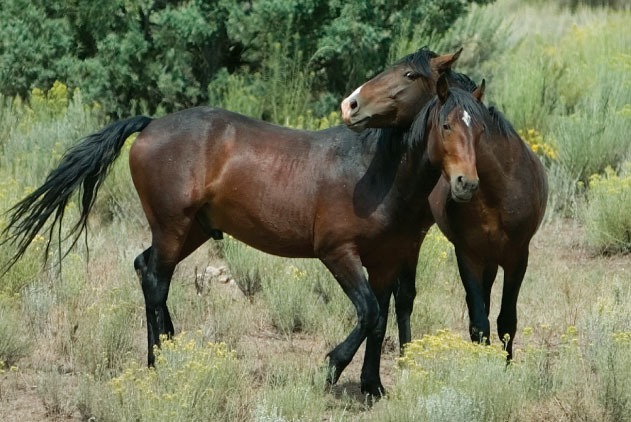
Dulce and Chama are typical bachelors, finding security and companionship in each other. Their gentle personalities are so addictive that we’re content spending much of the morning watching them interact with each other and their homeland.
We break for lunch high on a hill, at a makeshift camp set up by Dan Elkins, a wrangler contracted by the government to round up wild horses and haul them to holding facilities where they can be adopted. A fifth-generation New Mexico rancher, Elkins grew up on Mount Taylor, home to one of the few remaining free-roaming Colonial Spanish Horse herds in the United States. An advocate of the wild horse, Elkins has spent most of his life studying their routines, educating the public on the animals, and ways to humanely capture and treat them, as well as implementing safe, effective population-control methods.
Although it pains Lynne to see bands of horses rounded up, she says she rests assured that they’re handled properly under Elkins’ guidance. The reclusive man sets out inner tubes filled with salt to attract the horses. Using wireless infrared technology, he monitors the horses at the feeding areas during the night from a computer screen in his camper. When the government declares that a roundup is imminent, Elkins sets up portable pens with electronic gates around the feeding area. At the push of a button, he can close the gate, corralling the horses without stress or harm.
Applying his knowledge of band behavior, Elkins next loads the horses into a trailer, free of injury. Once he drops the animals off in town, they’re in the hands of the forest service.
AFTER LUNCH, WE TREK FARTHER INTO THE PRESERVE, following hoofprints in the sandy ground. The road becomes steeper, narrower and rougher, but wild-horse sightings become more frequent.
There are anywhere from five to 15 horses in a band, and DNA testing shows that the Jicarilla herd is of mixed ancestry. As mechanization developed in the late 19th and early 20th centuries, horses were released onto the range, where they’ve roamed freely ever since.
Most of the Jicarilla horses have deep, glistening brown or bay coats, but through the years, color has infiltrated the herd. It’s not uncommon to see sorrels, liver chestnuts and Paint coat patterns. The horses are larger and stouter than I expect, standing between 14.2 and 15 hands, with straight legs, dense bone and thick, healthy hooves that are maintained naturally by the terrain the horses tra
vel. Many of the horses have the conformation to be decent ranch or recreational mounts.
Teach your horses to keep their focus and moving straight ahead in the article Loose Horses.
SCOUTING WILD HORSES requires hours of slow driving and good eyesight. If someone spots what appears be a horse in the distance, the caravan comes to an abrupt stop. Some of the horse sightings turn out to be real; others are mirages.
We scour the hills within Chicosa Canyon, Bancos and Cabresto Mesa. As co-pilot, I keep binoculars pressed to my eyes so I can catch any sign of horses, such as tracks or manure piles. I’m so focused in the distance that I almost miss the action occurring in front of me.
Wide-eyed, with his mane blowing in the wind, a stallion breaks from behind the trees at blurring speed and gallops across the road, nervously squealing for his band. Lynne promptly slams on her brakes, and everyone jumps out of the vehicles, quickly focusing lenses on the social situation unfolding before us.
Soon, a second stallion bolts from behind a hill and chases the first. Lynne speculates that the latter, younger stallion has just taken over the first stallion’s band and is running him out. The pair aggressively kick and shake their heads while whipping back and forth across the road several times, then they disappear over the horizon.
Moments later, the younger horse emerges, but there’s no sign of the first stallion. We can only assume he retreated before suffering dire consequences.
That afternoon and the following day, we forge deeper into forested terrain up to Carracas Mesa, where we observe spectacular high-desert scenery, meadows dotted with wildflowers, fowl and wildlife, including a bear cub and several more horse bands. Lynne points out that each band not only has a stallion, but also a lead mare that the rest of the horses trust and follow. The dominant horses and bands eat and drink before the others.
Communication within a band, or between bands, is subtle, constant and crystal clear. Inconspicuous body language, such as nuzzling, tail swishing, head nodding, ear flicking and pawing, speaks volumes in a wild-horse herd, and elicits immediate actions.
Each band we encounter seems so different from the others. Some allow us to meander nearby for a closer glimpse, while others erupt into a thunderous fury at the sight of humans. At Elkins’ camp, we spy a band with an inquisitive satellite stallion named Brazos. As we slowly step toward him, he begins to approach us, nodding his head and snorting. Lynne removes a plastic grocery bag she carries in her pocket to deter brazen horses from coming too close. As soon as we stop, turn our backs to the stallion and take a few steps back, he also stops. Lynne says this approach-and-retreat method is the least threatening way to get a closer look at the horses.
THE FINAL DAY OF THE WORKSHOP is about reflection. Everyone shares her favorite images and recollections. Joanne and Rachael are motivated more than ever to find homes for the horses standing in holding pens. Lynne, who wrote in her book, Among Wild Horses, “the horses changed my life,” will continue her crusade to preserve the animals and their habitat. As for me, I hope my written and photographic journey sparks others to join the woman in her quest, and to witness, up close, the enduring beauty, courage and independence seen while wandering with wild horses.
Jennifer Denison is a Western Horseman senior editor. For information on Lynne Pomeranz’s educational workshops, call (505) 897-4108, or visit wildhorseworkshops.com.