

Again, Ralston says, it shows a horse a reason for the maneuver without a lot of pressure.
“It really helps teach a horse to do the mechanics and keep the footwork precise,” he says. “You can have that horse rate to its stop, finish its stop completely, and then be able to balance the horse and rock it back on its hocks. You want the mechanical cow to turn slowly and then speed it up out of the turn. That will draw the horse up out of its rollback.”
In the reining pen, he says, the rollback is a “high-intensity maneuver,” so a horse needs to learn to relax coming out of that turn.
“Remember, that horse just exploded into a rundown and into a stop. Now, if it’s got any anxiety about the rollback, it can get a little crazy and out of control,” he says.
The rollback itself needs to be explosive, but the horse needs to remain confident and calm, Ralston explains.
“If you can keep that horse confident and relaxed, then you can contain all that explosiveness of the rundown and sliding stop, and have a horse that explodes through a rollback and relaxes as comes out,” he says.
The mechanical cow also comes in handy for younger horses, Ralston adds.
“I use it to teach my young horses basic footwork,” he says. “I don’t always have great access to cattle, so when I do get to use cattle, the last things I want to work on are body alignment, dropped shoulders and footwork. I want to work on connection [to the cow].
“The mechanical cow teaches a young horse to stop square and rock back on its hocks. Then, when we do get to work cattle, we can focus on the timing of our horse with the cow and utilize the cattle better.”
Show horses typically take a good bit of warm-up time before they can be either worked or exhibited, but Ralston finds that giving them an alternative way to work off their energy is more effective than simply loping in circles.
“Often, we find ourselves loping these reiners around for 30 minutes before they’re mentally ready to learn,” he says. “That’s partially due to the anxiety they’re associating with the training program.”
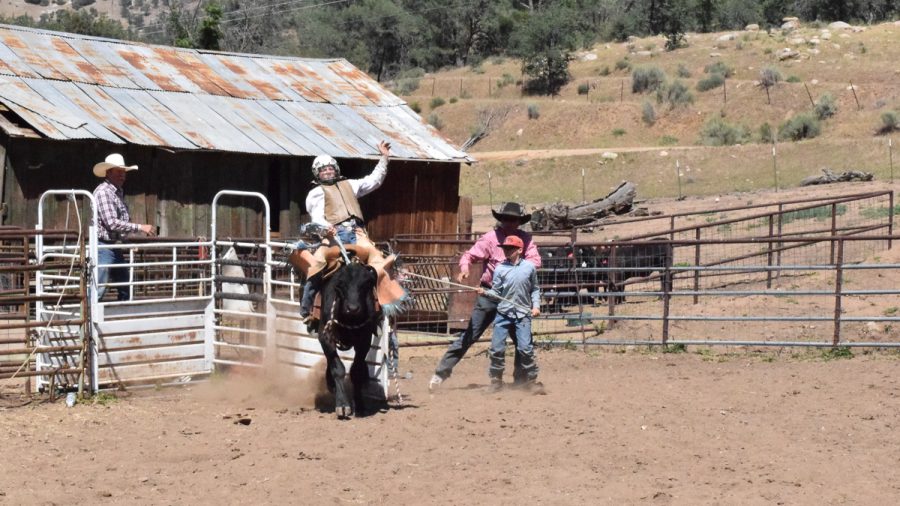
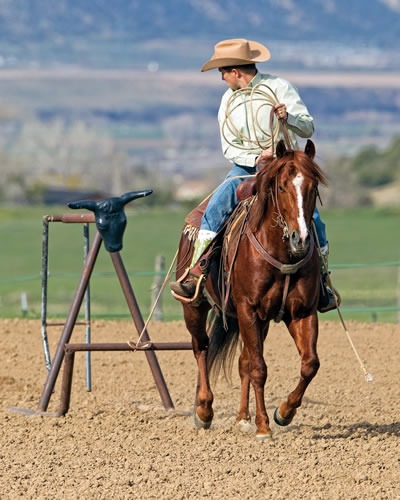
Ralston uses a roping sled—a dummy dragged by one horse and rider that allows a second rider to practice roping skills—for all of his horses.
“One of us will hook onto that sled and drag it around, and another person will rate around and rope it,” he says. “Again, it gives your horse a purpose. The horse might not know why he’s pulling a roping sled, but he is. He understands that and accepts it. This exercise also builds some muscle in a horse, and can really help strengthen a horse’s stride.”
Ralston uses the roping sled with all of his horses, no matter their occupation.
“I rope steers and use the roping sled on every horse I have, just for something to do. I try to add as much variety as possible for my horses in training,” he says. “Even at the end of a good reining workout, I’ll grab a rope and just track a couple of steers around, swing, rope and stop. I might just do that two or three times, but if I do something at the end of each reining workout that has a purpose, that helps my horses understand.”
Ride a Trail Course
Lately, Ralston has become interested in ranch versatility, so he makes use of a small trail course as part of his training regimen.
“Setting up any kind of trail course is phenomenal,” he says. “It helps a horse know where to put its feet and gives them something to focus on.”
Even setting up a few logs for a lope-over is effective, he says.
“It’s something for that horse to think about that’s out of the ordinary, and it engages his mind,” Ralston says. “It doesn’t allow him to just wander off into a numb mental state that they can easily go to.”
His home trail course includes a bridge, and he also makes use of the gates on his place to add an extra lesson.
“There’s nothing better for a horse than to go in and out of a gate,” he says. “Pushing or pulling a gate, you get to work with every part of the horse’s body, including all four feet. You have to have control over everything on your horse to get through that gate. You’ll really find out whether a horse is broke.”
When he’s riding outside, Ralston will ride over natural obstacles, such as fallen logs or rocks, and around or through sagebrush. That helps his horses learn to pay attention and be aware of where their feet are.
“Any sort of uneven terrain will keep your horse mentally engaged and connected to their feet,” he explains. “A horse’s foot has a connection to the brain. Therefore, if the brain is losing quality in the arena, let their feet do the talking and leave yourself out of it.”
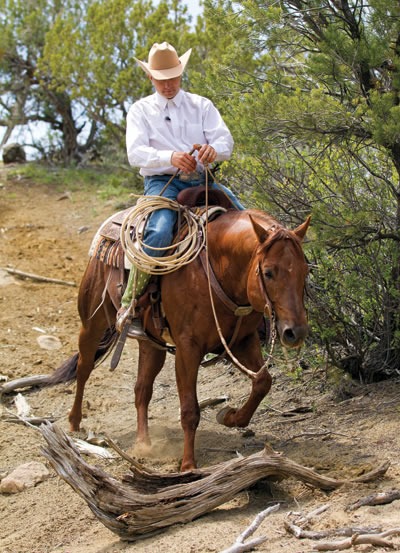
ounter logs, rocks or brush.
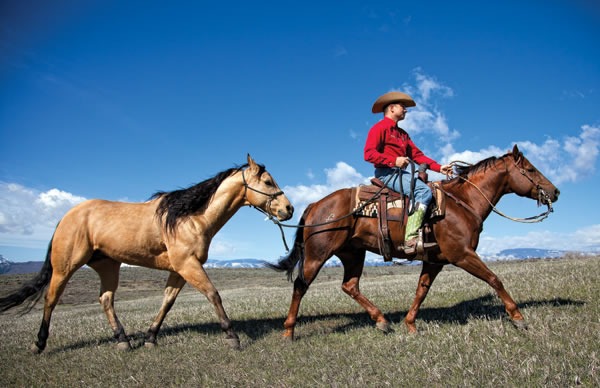
If you get bored trotting or loping circles in an arena, imagine how the horse feels. Ralston prefers to spend as much time outside as he can, whether it’s driving cattle from one pasture to another or simply taking a relaxing ride.
“I love any opportunity to work cattle outside,” he says. “I love to track cattle or tag calves or separate bulls out in the open. There’s a purpose to it, and the horse begins to understand that.”
Ralston believes that such work not only gives the horse an understanding of a job, but also makes the horse think on its own.
“There are so many different situations that the cattle will put you in that you cannot duplicate in the arena,” he explains. “Working cattle truly raises the intelligence of that horse. The experience makes them more confident in an arena situation. It allows them to learn to read a cow. It absolutely will brighten up your horse in the arena and allow him to work better and smarter, because he has more confidence and more knowledge.”
The trainer uses outside work as a building block for his young horses, but sees it as something of a therapy session for older, burned-out or fearful show horses.
“Where I’ve seen the biggest impact is on the older horses,” he says. “With the young horses, it’s more preventative. If they’re started with some kind of objective-based training, then life is much easier. But most of my business has been from people who have brought me horses that have developed bad habits. The worst thing I can do on a horse like that is to go drill on that horse [in the arena].”
Ralston says that kind of riding may “fix” a horse in the short term, but “in the long run, it just gradually gets to where the battles get bigger and bigger.” Instead, he gathers cattle or simply puts some miles on them by riding up the hills near his ranch.
“If I can take those horses up and down the hills—and they’re not easy trail-riding hills, they’re straight up and down—they learn there’s a time and a place to use all the energy they’ve got,” he explains. “It’s like a ranch horse that may get ridden for six or eight hours or longer. He doesn’t get in a hurry. He knows there’s another few hours ahead of him.”
The same goes for 2-year-olds that are just getting a start. Those youngsters also benefit from either rides out in the hills or being led from another horse.
“We’ll take those 2-year-olds out after we’ve done the round-pen work,” Ralston explains. “We’ll pony them to the top of the hill, and then rest and do some desensitizing with them. Those long, slow workouts allow that younger horse to process what’s going on. In the round pen, we’ve often got a small window where we can accomplish something with our horses, and then it turns into a battle of running the horse around until it’s tired, and there’s just no purpose in that. A lack of purpose builds up his anxiety and nerves. By taking them out to the hills, we set them up to learn. There’s less stress coming from us to them, and it makes the process easier.”
Show horses that only get ridden in an arena also are likely to develop anxiety, Ralston says. Ponying or outside riding can also benefit them.
“Longer, slower rides are the best approaches to rehabilitate some of these older horses, especially reiners,” he says. “They learn that there’s going to be another hill once we get down this one, so there’s no need to get in a hurry. If you run down the first one, it just means you’re going to have to climb the next one sooner.”
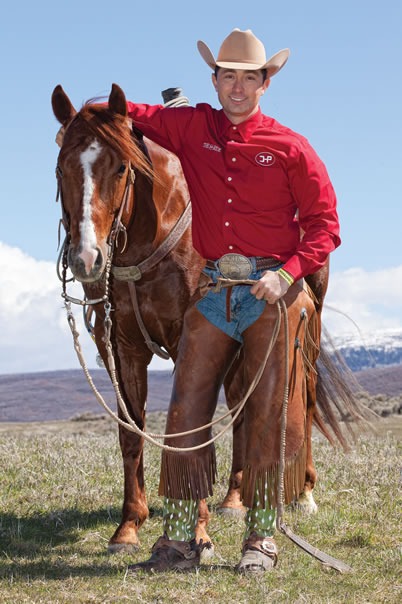
Aaron Ralston grew up on a ranch in Collbran, Colorado, fewer than 100 miles from the Silt Ranch where he lives and trains horses today. Riding ranch horses and roping, he dreamed of making the National Finals Rodeo. In his early 20s, he worked for Doug Millholland, an established reining trainer, and says that changed his life.
“He was the biggest influence in my show career,” says Ralston, who also credits Millholland’s father, Herb “Junior” Millholland, as a mentor.
Ralston earned his first National Reining Horse Association paycheck in 1999. Since then, he has won more than $143,000 in reining and reined cow horse competition.
Aaron and his wife, Meg, own Smart Paul Olena, a stallion by Smart Chic Olena. In 2004, that horse carried both to American Quarter Horse Association reserve world championships—Meg in amateur reining and Aaron in senior reining. Meg returned to the show in 2005 to claim the amateur world championship. In 2006, Aaron rode Smart Paul Olena as part of the U.S. gold-medal-winning team at the World Equestrian Games in Germany, where he also won the individual bronze medal. In 2009, he rode Spending Peptos Money to win the novice horse division of the Circle Y Ranch Derby, where he also was reserve in the intermediate open.
Ralston trains horses for reining, versatility and reined cow horse competition, coaches amateur and youth riders, and gives clinics. In 2010, he provided on-air commentary for NBC Sports from the reining competition at the World Equestrian Games in Lexington, Kentucky. He was past host of “The Ride” on RFD-TV.
The Ralstons have two sons, Parker and Colter, who have inherited their parents’ love of horses.
Susan Morrison is managing editor for Western Horseman. Send comments on this story to [email protected].