
He’s comfortable giving direction in any of the organization’s four events, but might be best suited to the trail class.
“I learn more from the clinics than many of the people who pay to be there,” he admits. “I wasn’t always sure I was ready to be there as a teacher, but I guess somebody once said, ‘If you want to learn something, then teach it.’ After doing it for a few years, I think there’s some truth to that.
“Teaching puts me in a position where I have to think about a problem and what might be causing it. Hearing other people talk about problems they’re having really gets me thinking. And since I ride horses every day, I have a lot of time to think about those problems after the clinic is over.”
Jimbo has also benefited from judging SHOT and RHAA shows.
“Being on that side of the table has helped me tremendously,” he says. “I know what that judge is thinking. Having sat in that chair has made me a little more relaxed about things when I’m competing.”
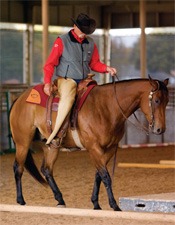 Among the most important advice Jimbo offers students in the trail class is to look for opportunities to work with your horse every time you ride.
“Everybody has gates on their places,” he says. “Focus on going through those gates the right way. I know it’s tough, because a lot of people go to an office every day and might only get to ride on weekends. I wake up surrounded by this stuff every morning, and that’s a huge advantage.”
Jimbo has a makeshift trail course setup
at his home, but uses it sparingly. He leads yearlings through the course and allows them to become accustomed to the obstacles long before he climbs into the saddle. But after that, he’d rather use his daily rides through the pasture as a chance to tune his horses.
“It got to a point where my horses had lost their expression in the show classes,” he admits. “That’s when I realized I was schooling them on this stuff a little too much. I encourage people to realize that riding through a pasture is a great opportunity.
“There was a time when, if something spooked a horse, people would just avoid whatever that was. Now we know it’s best to confront these fears and think of it as an opportunity to fix the problem.
“A lot of cowboys really fight the trail class, but they have the best opportunity in the business to be good at it. We spend half our time or more just riding from one place to another. That presents countless opportunities to work on the types of obstacles in any trail class.”
THE JOURNEY FROM RUNNING a fencing crew to becoming among the most-recognized competitors in ranch-horse competitions has been an interesting one for Jimbo. Along the way, he spent time as a chuckwagon cook for many of the West’s largest outfits, and even ran a cement plant and lumberyard. Almost by accident he found himself in the middle of chuckwagon cookoffs and spent a few years winning awards for his efforts.
“It was just one of those deals that life throws at you,” he says. “I was running a fencing crew working on some big ranches in West Texas, and I was having a hard time keeping hands. So I decided I’d just load them up on Monday morning and we’d stay on the ranch until the work was done. I started cooking for the crew, and then a couple of ranches asked me to cook for their cowboys. Then I started running a chuckwagon full-time and stayed pretty busy from February to July, then from September to Christmas.”
The experience gave Jimbo the chance to work on a variety of large ranches from West Texas to Nebraska, something he’d missed out on when he walked away from ranch life during his 20s.
“A lot of kids do that right out of high school-jump from ranch to ranch for a few years and learn a lot from the old hands there,” Jimbo says. “I missed out on that, but got a chance to do it later in life. I got to work with some great cowboys during that time, but eventually it got to be just plain old manual labor. The competitions were changing, too, and so I just got out of it altogether. But it sure was fun to work on some big outfits that still try to do things the traditional way.”
Jimbo had also begun building bits and spurs during his downtime on the chuckwagons. Eventually, he got his son, Matt, into that business and turned the metal-working over to him. Since then, he concentrated on his ranch work and developing his horsemanship skills.
“There are some things in life that you get so good at, you reach a point where there’s nowhere else to go,” he says. “But this horse deal is never-ending. There’s always room for a horseman to improve. Horses get old and we have to start over with a young one. Not every horse pans out to be a show horse, so it’s a never-ending process.
And let’s face it-every old rancher wants a horse good enough to take to town and show off, even if it’s just once or twice a year.”
Jimbo got a chance to show outside of Texas when he and Catchum qualified for the first AQHA Versatility Ranch Horse Show in Denver, Colorado, in 2008. The pair finished fourth overall, despite spending considerable time “in the penalty box.”
“That was a really special learning experience for me,” Jimbo says. “We just barely qualified to get there. We had one point and went to a show in Albuquerque and had a bad show. Then we came back to Amarillo, and I had a couple of days to get my head screwed on right. We won that show and got qualified.”
The toughest part of riding in the AQHA competition was the stricter set of rules than those used in SHOT or RHAA. Jimbo says the best advice he can offer for contestants in multiple ranch-horse associations is to ride by the strictest rules every time out.
“The SHOT rules are a little more forgiving, so going to Denver made me realize that I needed to clean up my act a little bit,” Jimbo says. “There are times when I have to be a little more prim and proper or it will hurt my scores. So, the easiest way to keep it all straight is just to ride that way every time.”
At age 55, Jimbo looks back on his life with horses and likes the changes he’s seen.
“When I was growing up, a top hand was an old boy who could ride an unbroke horse and get a day’s work done,” he says. “Now, a top hand is a guy who can get a horse pretty broke and enjoyable to ride. That’s the difference for me from now to then.
“Growing up, I thought you had to ride that old rank horse. Funny how things change.”
Kyle Partain is a Western Horseman associate editor. Send comments on this story to [email protected].