
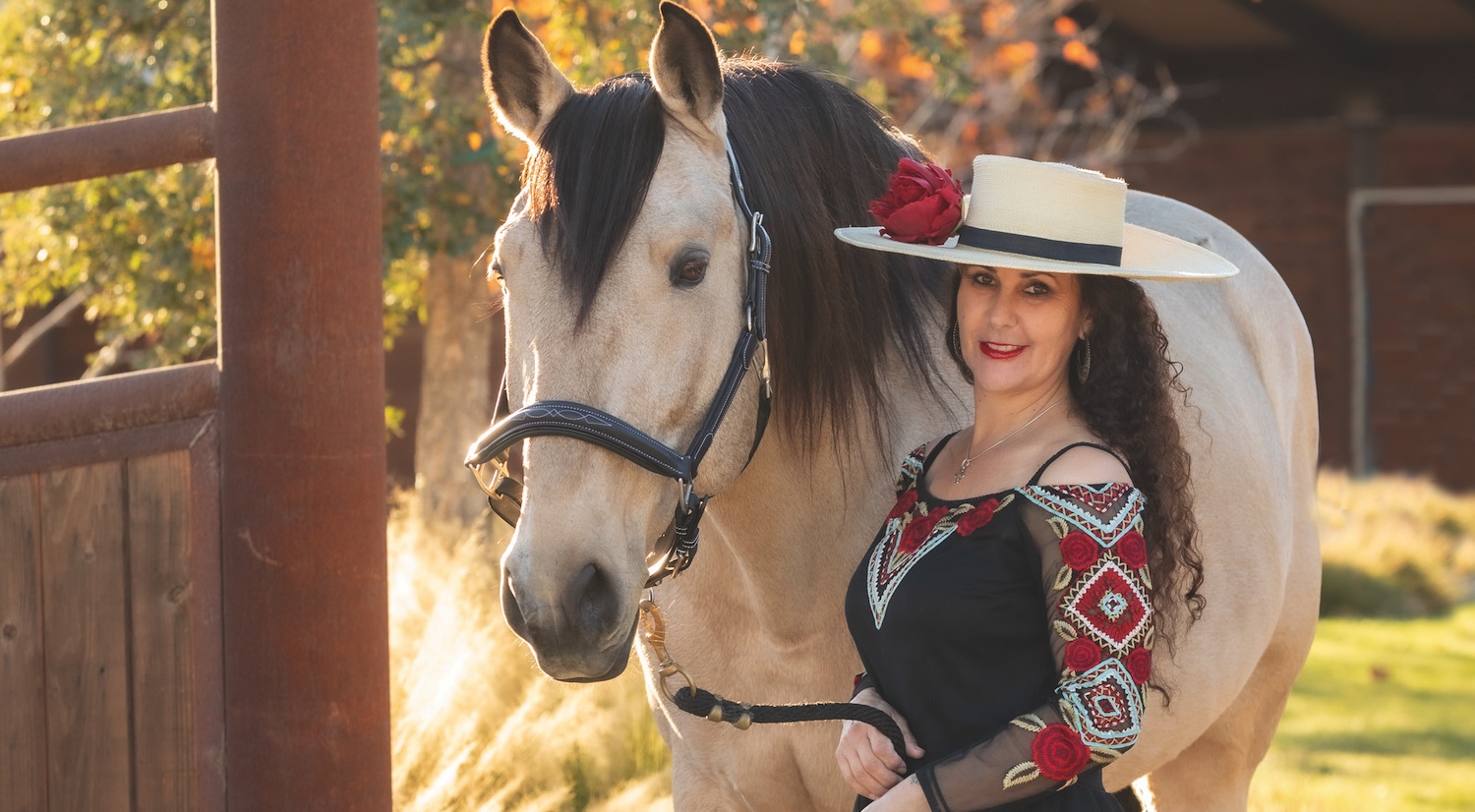
Mastering the art of equine connection, Nicole Chastain has soared to impressive heights as a trainer, competitor and judge across several disciplines.
From cattle ranches to competitive arenas, Nicole Chastain has mastered the art of the crossover. Riding alongside a string of experienced mentors throughout her life, Chastain has studied a diverse range of Western and English disciplines, including dressage, eventing, reined cow horse, team penning and sorting. The art of dressage became her root passion while fostering an advanced understanding of equine movement across breeds and disciplines.
Her eye for equitation and horsemanship led Chastain to earn her judge’s card in multiple associations, with her credentials including Dressage and Western Dressage “r” judge for the US Equestrian Federation, as well as an “S” judge for USA Working Equitation. She is also a United States Dressage Federation medalist and certified instructor, who continues to coach and train in the Santa Ynez Valley of California. Diagnosed with Stage 4 cancer in 2018, Chastain has continued to pour herself into horses, proving an equine connection can be both healing and motivating. That is the outlook she continues to encourage through her work.
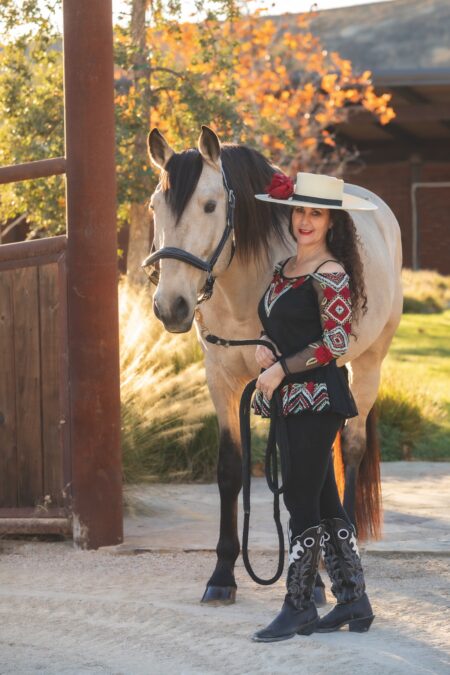
Photo by Christine Photography
Horses are everything — such amazing creatures. I really think that God made a pact with them and us a long, long time ago to be companions, just like with the dog. They’re so intuitive, and because they’re prey animals, they feel things and are so attuned to everything around them, including the emotions and the energy of the people that are with them. I don’t even like to call what I do with horses “training” because it’s really relationship building. For me, horses have taught me how to heal myself, and [the only way] I can explain how is they show up for you every day. It’s an unspoken connection that anyone who learns to be still and lay their hands on a horse is going to feel.
For people who have been in a situation where they’re diagnosed with something that is really life-threatening, [it can get to] the point where it really separates you from everyone around you; they don’t know what it feels like to have a ticking time bomb as a diagnosis. For those who are going through that, or even struggling with something mentally, I strongly encourage horses to be a part of your life because they don’t care what kind of day it is. They need you to show up for them, and that kind of responsibility for another living being can’t be duplicated.
My passion will always be dressage, [specifically] the training of dressage in the sense that it is just this practiced, organized way of going about creating the same language with a horse that then becomes invisible language, crossing over into art. That is where my heart will always be, and not in a competitive ring. It’s why we get up at 6 in the morning and do what we do every day — to get that connection with the horses. It doesn’t matter which saddle or bridle you have on that horse, but it is developing that connection. The horses want to tell you their story if you’re willing to listen to them.
I think it’s really important to go back and forth between training methods so that you understand which horse needs what at which time, and also be flexible to change it up. That includes going back to a lot of Western principles as well. I’ve kept refining my training and looking at all the different places I could learn from.
[Working equitation] has four phases: dressage, obstacle, speed and cattle. A dressage horse should be really responsive, right? So, if you have the right horse, it should be able to go, come back, turn on a dime and follow. It’s really interesting to watch the different styles in which people work cattle, but they’re all using the same principles of angles, pressure and release. The cattle trial is a bit like line sorting and penning combined.
The Western horses can be really competitive. They aren’t as uphill or ground covering, but the sport is not about how fancy your horse moves; it’s how efficient your horse moves over the ground, and how your horsemanship translates to working horsemanship.
I got into the judges’ program with [USA Working Equitation], and I’ve put all my energy towards the sport for the last five years. I got my “S” judge’s card, which is the highest card in the United States. I’ve also done some training in Europe with [World Association Working Equitation]. I would love to someday be an international judge.
Being a woman of the West means you have to be really driven, really resilient. It’s not an easy industry to make it in professionally, no matter what clothes you’re wearing. You have to be really open-minded because there’s always going to be someone who is better than you. You have to make your priority about something bigger. If you can find your wins in the smaller moments, I think that’s what living with horses is about.
One of the most knowledgeable, Horse women our times and someone I definitely look up to as a trainer. Yet another well-thought-out insightful article woven words by the brilliant intelligent wordsmith herself.