
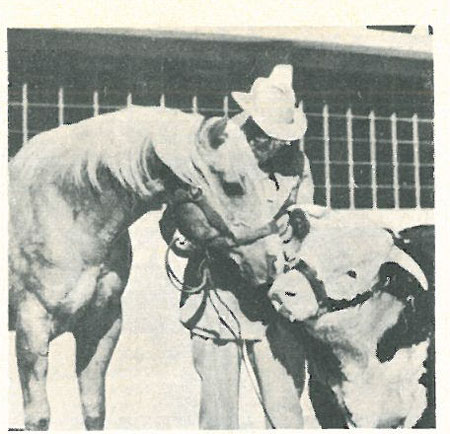
 Grand Duke and Hiwan Helmsman 73rd both refused to pose for this month’s cover until proper introductions had been made by John T. Caine III. Photographer Clarence Coil snapped this picture as the social amenities were in progress.
The display of individual breeding cattle lining up before the judges among all three breeds has grown in size and quality until it has become each and every breeder’s ambition, if not to win, to place near the top at Denver. At the same time, the market for breeding stock has broadened arid strengthened until the national slogan is “sell at Denver,” livestock breeding capital of America.
But the most phenomenal rise among livestock at Denver’s show the past decade has been the spirited development that the Stock Horse exposition has accumulated. Quarter Horse and Palomino judging draw as much attention as the breeding cattle contest in the modern National Western show ring. Always, the fancy horse show was popular in the arena performances. Now the hundreds of keenly interested horse followers eyeing the top equine entries before the judges in the ring are joined by a mass of cattlemen, moving from the beef classes to the horse classes, so intent is their interest in both.
One of the most popular events of the rodeo and horse show performances for the city resident as well as the rural visitor is the cutting horse contest. And the 1952 National Western will introduce the judging of halter classes of Quarter Horses, Palominos, and Arabians in the new Denver Coliseum arena. Walking Horses also are included in the January horse show.
That this, the people’s stock show, has accomplished far more than Elias Ammons and Fred Johnson ever dreamed back in 1905 is beyond all question. The difference between the feeding and breeding stock of that era and today is like the difference between the work oxen and the 1951 grand champion steer. Feeder cattle, once exhibited as big, rangy yearlings and two-year-olds, now are popular as neat, blocky calves.

Originally, the National Western breeding show was divided into two sections: One open to the nation, the other limited to territory west of the 102 meridian, taking in all of Colorado and states West. Within a few years, though, breeding in this Western area had developed so rapidly that it could easily compete with all of America. The Western classifications were discontinued. In the 1952 event the rest of the United States will be laying on the whip in the stretch to come in the money and honor with the Western herds, if possible.
Thus, from the home grounds to the show grounds rides the progress in animal production, stimulated by annual competition at the National Western. You will find that animal progress up and down the long alleys of the stockyards, in the show barns and in the show ring… if you can break through the knotted crowds of interested stockmen from throughout the land.
It has been well said that if you are a stockman and you stand in one place long enough during the course of the National Western, you’ll see everyone in the livestock business that you ever knew, and everyone that you would like to know.
Denver’s new Coliseum, with its 8,000 seats and unobstructed view, heralds a new era in the career of the National Western. But it still will remain that the nation’s people and their livestock will make the show – and upbreed the progress – because they will all be there.
Not a subscriber? Click here to subscribe to Western Horseman magazine.