
The rodeo became more accessible when Interstate 635 was built nearby, and in 1964 Neal added an arena roof, so spectators would be comfortable even if it rained. Gradually, the contest began to attract more and more spectators. It became a popular source of entertainment for area residents, and also afforded young cowboys a place to practice and compete with some of the top contestants in the nation. There are many in rodeo who got their starts at Mesquite; one of them is twice world champion saddle bronc rider Monty Henson, a family friend who grew up with Don.
Neal Gay has long been a respected stock contractor. He produces a limited number of other PRCA rodeos in addition to the Mesquite contests, and his special “Western spectaculars” —a blend of rodeo action and other entertainment—are popular with convention groups. Neal also has become a source of bucking stock for other stock contractors, particularly in the bull department. Some of the most formidable bulls in the last 20 years got their start at Mesquite.

Cross-bred Brahmas like the legendary Tornado—voted best bull of the National Finals five times during the 1960s, and now buried at the National Cowboy Hall of Fame in Oklahoma City—started his career at Mesquite before Jim Shoulders bought him. There were others, like Booger Bear, top NFR bull of 1968; Tiger, owned by Billy Minick when he was named best at the ’72 Finals; and Ringeye, the top bull of 1974. Most recently, Mesquite’s Ruff and Ready was voted top bull of the 1980 Finals. Bulls like The Honker, Mission Impossible, Sandy Jo, Lightning, Billy Bob, and the fierce high-horned fighting bull Buster have all been part of Mesquite, and the National Finals.
Last year Mesquite Rodeo Corporation had five bulls selected for the Finals, in addition to four saddle broncs and four bareback horses.
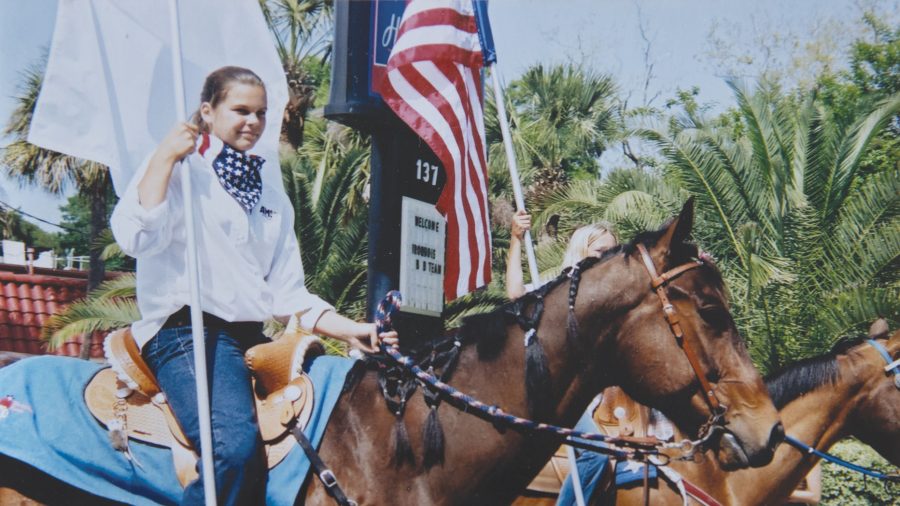
Neal continues to locate and purchase good prospective bucking stock for his own use and for sale to others. He maintains around 400 animals on two ranches near Mesquite, and employs 30 people. The entire family is also involved in the operation, including wife Kay, a good barrel racer and all-around hand who is in charge of the saddle horses, doubles as costume designer for the flag bearers, and also does much of the official timing for the contest events.
Pete Gay, who qualified for a third Finals before retiring from full-time competition, devotes his efforts to the family business. He and youngest brother Jim are pickup men at the rodeos, and Jim, 18, also won the 1981 bull riding and all-around titles in Texas high school competition. Don’s wife of five years, Terri, serves as rodeo secretary.
Take a glimpse into Kay Gay’s “costume closet” in “Grand Entries” here.
Don helps out whenever he’s home, but full-time rodeoing doesn’t leave much time for home life. Riding bulls and winning championships is his business; when the day comes that Don puts his bull rope away for the last time, he’ll become a stock contractor.
Don flies his own twin-engine Comanche to most of the rodeos these days, and the plane has a distinctive paint job. Late in 1981, he signed a promotion agreement with Miller Beer, and the plane now carries the Miller logo on the tail; lettering over the fuselage reads: “Miller High Life Flying Cowboy, Seven-Times World Champion Bull Rider Don Gay.”
The cowboy is a businessman, and he continues to make more money on the backs of bulls than anyone in the history of rodeo. In 1974, when he won his first championship, he set a new earnings record for the event—$32,917; with his second title in ’75 he earned $34,850; in ’76, $38,812, and in ’77, $41,574.
Don set another earnings record in 1978, even though he didn’t win the championship. From 1976 through ’78, the world titles were awarded strictly on Finals winnings. Don had come through with the biggest wins twice, but in ’78 he lost the title to Butch Kirby; Butch won $15,000 at the Finals that year, Don was second with $10,000, but his year-end total was still a new high of $48,275.
The system reverted back to what it was originally for the 1979 season, and Don won the championship with $59,999. His sixth title came in 1980, with $60,639; the seventh was earned in ’81 with $63,907. Figures are fine, but when fans think of Don Gay they probably don’t think of the money he has won. Most likely, they’ll think of specific rides they’ve seen him make, either on television or at rodeos they have attended. By virtue of the stock, many of these have occurred at the Finals: he set an NFR record in ’74 when he rode Bull of the Year Tiger for 94 points; he set a new NFR record with a 95 on Red One in 1976; he conquered the swift spinning bull Oscar for the last time in 1977, during a “ride off” for the championship with Randy Magers.
In recent years, rodeo afficionados have watched him overcome pain and adversity at season’s end. He showed up for the ’79 Finals with 63 stitches in his left side from injuries suffered at a rodeo only a few days before. In ’80 he had his ribs torn in the fourth round, and came back to win first the next night with a 77 score. Last December, Bull of the Year number 105 added injury to insult when he bucked off Don in the first round and mauled him. Don went to the hospital for eight stitches in his head, and returned to ride and win—business as usual.