
On his return trip, with two or three grain sacks of herbs and his blanket roll, he’d stop over for three or four months. About this time, the spring round-up was getting under way and haying time was soon to start, so he was the cook for the whole outfit.
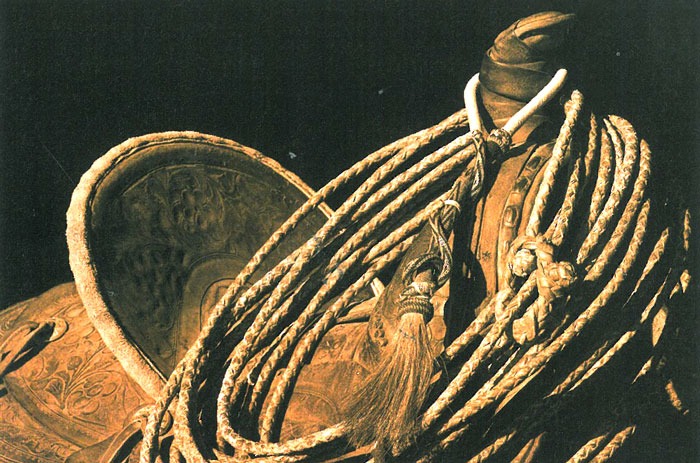
Like many youngsters raised on big cow ranches, with plenty of stock to rope and horses to ride, my first ambition was to have a reata of my own making. Hides were numerous, and I’d spend hours, day after day, cutting up a hide, scraping the hair off and trying to get an even strand.
I used to get plenty mad and tear things up, but when I got cooled off, I’d go back to it again and try to cut out my reata strands. They never came out as perfect as I wanted them.
On one of his stopovers as cook, Fernando became interested in my boyish efforts to be a rawhide braider. We rigged up a room in an old airy house, where I’d head just as soon as my morning chores were done, and wait for Fernando to give me my daily lesson. He taught me how to select good hides, prepare them and trim off the flak.
Fernando never talked much while he watched me braid, and would sit near with a long stick in his hand. If I didn’t pull a strand down just right, he’d reach over, tap me on the knuckles, and make me tear it apart and braid it over again.
A few weeks after he was there, he told me to see if I could make a bosal. I remember how eagerly I tore into the hide, cut my strands and made my bosal. After showing it off to the hired help, I took it to Fernando for inspection. He took one look at it and tossed it aside. I knew I was in for a good, old-fashioned lecture. He picked out all the uneven strands, the hair left on in places, the uneven braid, the unbeveled spots. It was, in fact, a no-good job.
Somewhat discouraged, I walked out with a drooping mouth. A lot of scoldings were dished out to me during my learning days with him, but this was one of the stiffest. The main point that I’ve always remembered was that Fernando made it clear to me that this kind of workmanship didn’t require any brains or skill. He wasn’t spending his time and patience teaching me to put out that kind of equipment, and expected something better than average. To this day, that’s been my goal.
I still wanted to make a reata, so one day Fernando turned me loose on a big 4-year-old steer hide. After trimming, and cutting out the brand and all the defects, I began to cut a wide strand around the hide and, of course, it was pretty uneven and wobbly.
Finally, the strands were ready for braiding. The reata was to be 25 feet long, as that was the general length used by a beginner in learning to rope. It was pretty tough work since I didn’t have the strength and weight to draw in and tighten the braid. Whenever a strand was pulled down too tight or not tight enough, Fernando would make me unbraid and do it again.
At the end of the second day of braiding, the job was done. It wasn’t much to look at – the braid was long and pretty loose, and some lumpy spots in the reata got away from even Fernando’s eagle eye.
However, at the time, to me, it was a swell piece of work.
This article was originally published in the May 1941 issue of Western Horseman.
Luis Ortega was one if the 20th century’s most influential horsemen and gearmakers. A close friend of WH founder Paul Albert, Ortega contributed 34 articles to the magazine. “La Reata” was among the first.