
Styles may look a little different from year to year, but these diverse ads from the archives of Western Horseman prove that jeans, boots and a good pearl snap are timeless.
Styles change. Trends shift. Colors come and go. But the core of Western advertising has always been about more than fashion alone. For decades, Western Horseman has documented how brands spoke to working cowboys, riders, horsemen and families through marketing that balanced durability with style.
In this second installment of From Trendy to Timeless, we revisit advertisements from the 1960s and 1970s to examine how jeans, hats, feed, clothing and animal health products were marketed to a Western audience. From leisure looks and family wardrobes to long-lasting denim and research-driven nutrition, these ads reflect a period when Western marketing grew bolder, embracing modern typography, punchy headlines and lifetyle-driven imagery.
maverick western wear
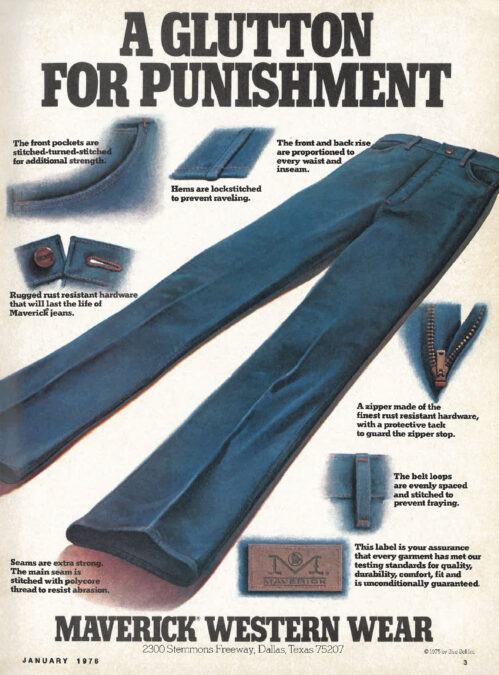
In the context of this January 1976 Maverick Western Wear advertisement in Western Horseman, the phrase, “Glutton for Punishment” is being flipped into a compliment. It’s aimed at riders and hands that work hard and need jeans that last. The detailed callouts about reinforced seams, lockstitching, rust-resistant hardware and heavy-duty zippers support the bold header text. In the 1970s, this kind of language was common in Western and workwear advertising.
Maverick Western Wear was a brand of Blue Bell Inc., the Dallas-based company that also produced Wrangler.
While Wrangler leaned heavily into rodeo and traditional Western identity, Maverick positioned itself with a lifestyle-oriented approach, blending durability with fashion-forward styling. The product-only layout, absent of models or lifestyle imagery, reinforces that message, presenting the jeans as tools rather than fashion.
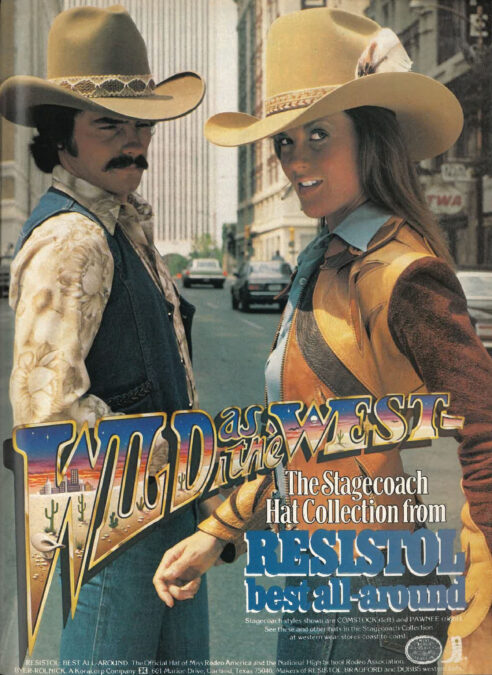
resistol
Appearing in the September 1977 issue of Western Horseman, this Resistol advertisement captures a pivotal moment when Western wear was expanding beyond the ranch and rodeo arena. Set against an urban backdrop, a sharply dressed man and woman in full Western attire stand confidently, showcasing Resistol’s Stagecoach Hat Collection.
The Resistol Stagecoach Hat Collection was produced for several seasons from the mid-1970s into the early 1980s. Marketed as a unified line, most styles featured a distinctive Stagecoach metal pin that reinforced the collection’s cohesive brand identity.
By identifying Resistol as the official hat of Miss Rodeo America and the National High School Rodeo Association in the footer text, the ad emphasizes the brand’s credibility within both professional rodeo and youth competition, positioning the hats as sanctioned, arena-ready Western wear.
merck animal health
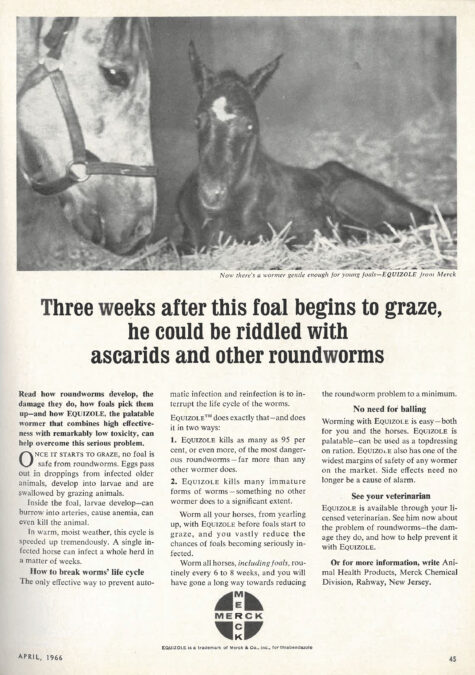
This April 1966 Merck & Co. advertisement is Western Horseman reflects a growing emphasis on preventative animal health as modern veterinary science became more accessible to horse owners.
Centered on the vulnerability of young foals, the ad underscores how quickly internal parasites could take hold once a foal begins grazing. Marketed as gentle, palatable and easy to administer, Equizole was positioned as a practical solution for routine deworming, signaling a shift away from reactive treatment toward scheduled herd health management.
The straightforward language and clinical tone mirror the period’s increasing reliance on veterinary guidance and pharmaceutical innovation, a trend that would continue to shape horse care practices for decades. Now known as Merck Animal Health, the company is a research-driven brand that develops, manufactures and markets a broad range of veterinary medicines and services.
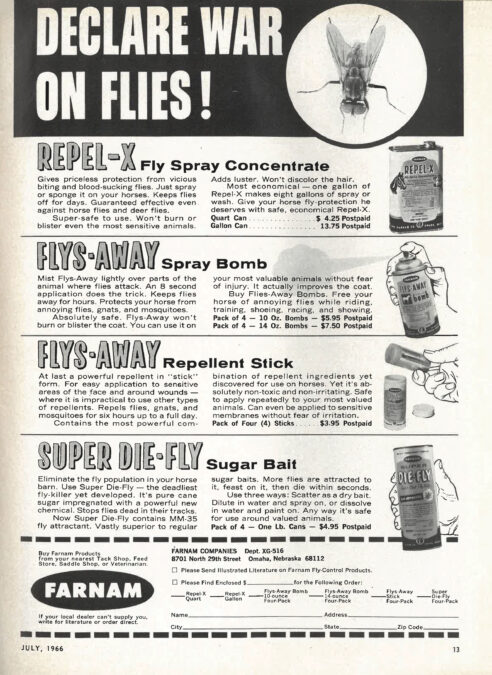
farnam
This July 1966 advertisement in Western Horseman captures the escalating battle against flies during the height of summer, when insect control was critical to horse comfort and performance.
Framed in large, attention-grabbing language, the ad reflects a period when chemical solutions were marketed as modern, decisive answers to long-standing fly problems.
With multiple delivery options, from spray concentrates and aerosol bombs to repellent sticks and sugar bait, Farnam positioned fly control as a comprehensive, system-based approach rather than a single product fix. While these products were widely accepted and popular in the 1960s, many of the chemical formulations and delivery methods have since been phased out, replaced by more regulated and environmentally conscious fly-control solutions used today.
Miller Western wear
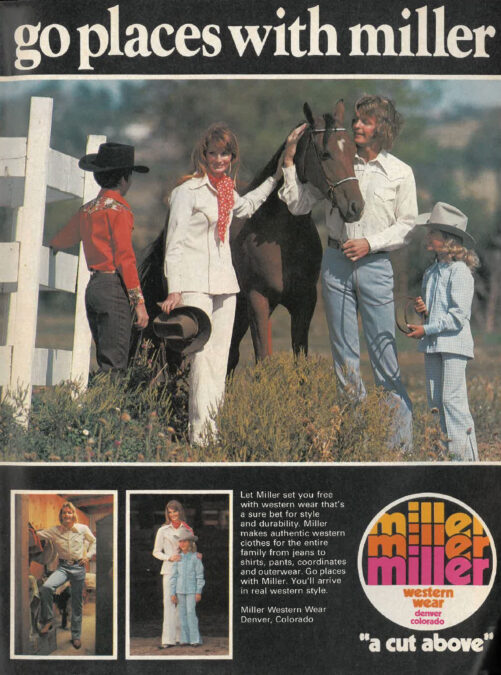
This advertisement from the May 1976 issue of Western Horseman reflects a period when Western wear was increasingly marketed as a complete, family-oriented lifestyle. Miller Western Wear traces its roots to a Denver-based company founded in 1918, a lineage that later evolved into Miller International and ultimately led to the launch of Cinch in 1996.
Centered on a posed family scene with what appears to be a young horse, the image positions Miller as outfitting every generation for both everyday wear and Western attire. The copy emphasizes durability, coordination and versatility, presenting jeans, shirts, pants, outwear and matching separates as part of a unified wardrobe.
By the 1960s, Western Horseman was established with full-color front covers and a mix of black-and-white and color photography inside. By 1976, color advertisements had become increasingly prevalent in print, as reflected in this full-page Miller Western Wear ad.
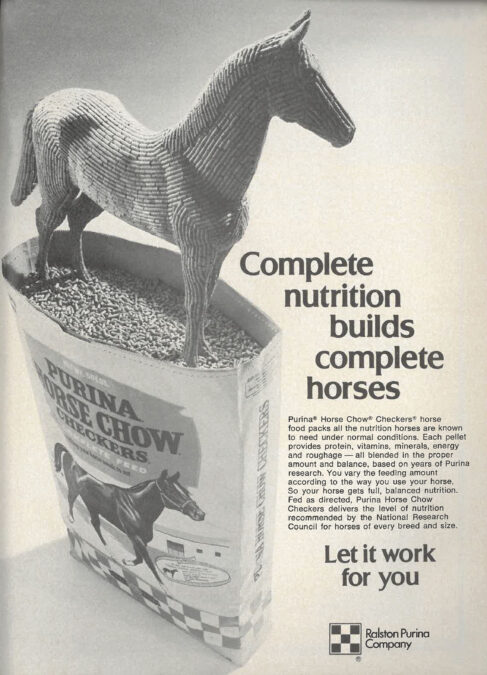
purina
This advertisement from the May 1976 issue of Western Horseman reflects a period when Western wear was increasingly marketed as a complete, family-oriented lifestyle. Miller Western Wear traces its roots to a Denver-based company founded in 1918, a lineage that later evolved into Miller International and ultimately led to the launch of Cinch in 1996.
Centered on a posed family scene with what appears to be a young horse, the image positions Miller as outfitting every generation for both everyday wear and Western attire. The copy emphasizes durability, coordination and versatility, presenting jeans, shirts, pants, outwear and matching separates as part of a unified wardrobe.
By the 1960s, Western Horseman was established with full-color front covers and a mix of black-and-white and color photography inside. By 1976, color advertisements had become increasingly prevalent in print, as reflected in this full-page Miller Western Wear ad.
panhandle slim
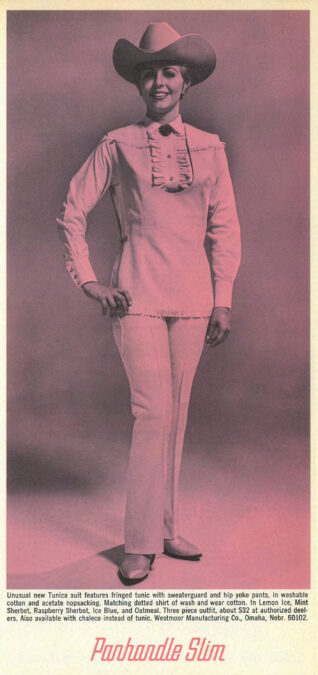
By the mid-1960s, Western wear advertising leaded into a cleaner, fashion-forward silhouette, as seen in this Panhandle Slim advertisement from the January 1966 issue of Western Horseman. The slim tunic top, hip-yoke pants and tailored lines emphasize a polished, mod look — a departure from earlier, utilitarian ranch attire.
Designed to be washable and easy to wear, the ensemble spoke to a growing market of women who wanted Western style that transitioned effortlessly from arena to everyday life. Soft pastel shades such as lemon ice, mint sherbet, raspberry sherbet, ice blue and oatmeal signal the era’s shift toward modern femininity. At the same time, familiar details kept the look rooted in the Western tradition that Panhandle Slim built its reputation on.
bailey hats
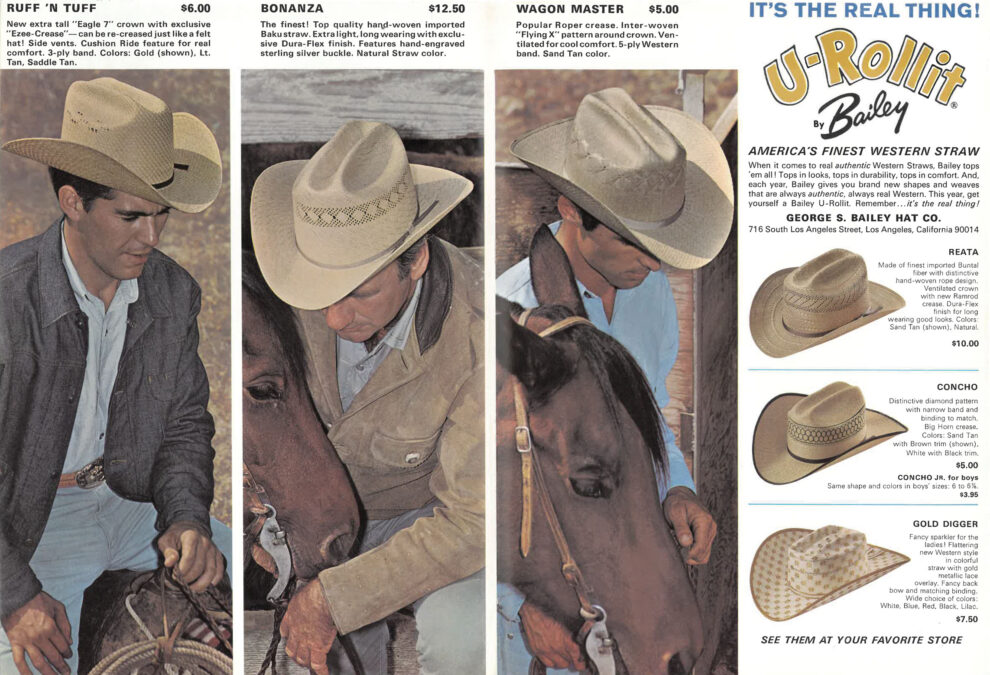
Framed by working cowboys and scenes with a bay horse, this 1966 Bailey advertisement in Western Horseman presents straw hats as “America’s Finest Western Straws.” George S. Bailey founded the Bailey Hat Co. in Los Angeles, California, in 1922, recognizing a growing demand for hats designed specifically for the Western wear market.
The ad reflects 1960s Western style, when cowboy hats featured noticeably narrower brims than the larger brim sizes favored today. Its U-Roll-It straw hats reflected a growing demand for authentic styles that could withstand daily wear, and long hours in the saddle while maintaining a structured shape. According to the May 1954 issue of Western Horseman, the Bailey factory introduced the Rattler straw with its adjustable “roll-ur-own” feature, known as the U-Rollit brim. Made of genuine Panama, this particular Rattler style features a brown pattern woven directly into the brim, which was designed to let the wearer shape it to their preference and keep its form.
This article was originally published in the April 2026 issue of Western Horseman brought to you by Martin Saddlery.