



Riding thousands of miles while cowboying and starting colts, and feeling how a horse moves, prepared this Wyoming horseman for his calling later in life as an equine therapist.
When Bill Hackett shows up to a barrel race, team roping or
Hackett grew up on his family’s ranch in the Powder River Basin of Wyoming, 26 miles south of Gillette. He herded sheep horseback and stayed with the wagon starting at 8 years old. He quit school and left home at age 14 to cowboy on ranches.
“Sitting in that schoolhouse looking outside was really boring,” he recalls. “I didn’t like that at all and wanted to be out on a horse.”
The teenager went to work for the Wagensen Ranch south of Gillette, and lived in an old homestead where he was solely responsible for 300 cows, 100 head of 2-year-old heifers, nine colts and one saddle horse that was “supposed to be broke.
“He’d buck me off every time I’d get on him,” Hackett says. “The Wagensens were really nice people and had a lot of really good horses, though, and we did everything horseback.”
Several of the mares in the ranch’s remuda
“My dad had four mares that were half Belgian and half Morgan, and every year he’d breed them to Eclipse, who stood at a neighbor’s place,” Hackett recalls. “When the Remount program ended, [rancher Edwin Earl “Cam” Camblin] bought the stallion and must have bred 200 horses to him every year. I rode a lot of those colts and they’d buck you

While working for the Wagensen Ranch, Hackett met Billie McClure, an aide at the local hospital. The couple married in
“If there was a hall of fame for
“I really enjoyed trailing sheep, because they’re easier to work than cattle. Some of the best horses I ever made were in
Hackett says he and Billie lived pretty well on a cowboy’s wage of $300 per month. They saved until they could buy their own ranch on Bitter Creek, near Recluse, Wyoming, in 1971. There they raised their two children, along with horses, cattle
Horses were and continue to be a big part of the family’s life on the ranch. They raised some of their own horses, breeding horses with foundation cow horse and racing bloodlines, both for ranch work and for Dusty and Jacque to ride in youth rodeos.
“We had a mare we called Sally, a big sorrel mare that [traced to] Texas Dandy,” Hackett says. “She kept us riding good horses for a long time. I think I was 50 years old before I ever rode a gentle horse. Then somebody would take those horses from me.”
For about 10 years, the Hacketts bought 3- and 4-year-old racehorses
“We’d give $300 to $400 for the horses and sell them at a set price between $2,500 and $3,500,” Hackett says. “The buyer would call and say he needed so many horses, and I’d take them up to him and ride them for him. In all the years we did that, only one of our horses didn’t pass the test.
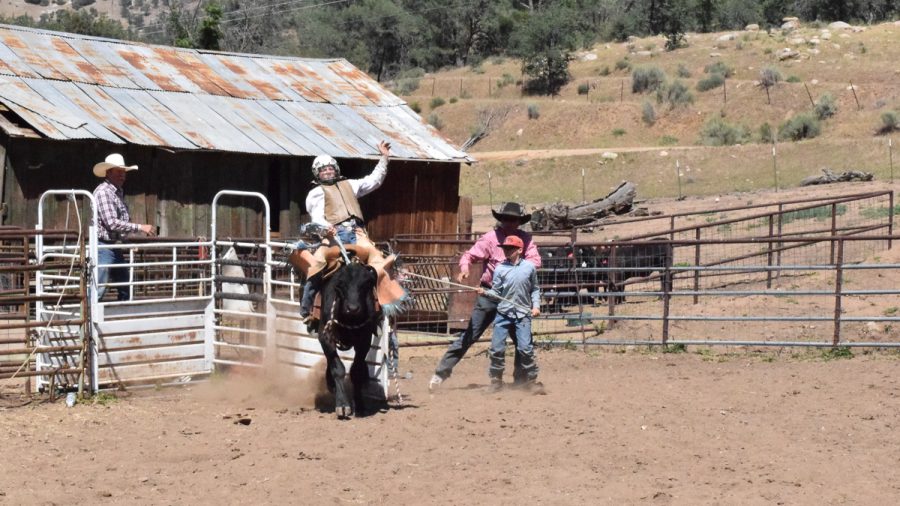
Though he didn’t compete much in rodeo, Hackett says he didn’t need to because he rode his fair share of rank colts and broke nearly every bone in his body, including his neck twice. One of the horses he remembers most is a Hancock-bred gelding named Buck.
“When I first got him, Jacque could ride him bareback with a halter, and Dusty roped off him, but when I got on him he might buck fiive or six times a day,” he says. “The last time I rode him was to ship steers. It was a cold morning and we had just got out of the corral and he took off
In the mid-1980s, Hackett sought acupressure treatment from a local therapist named Buster Harlow to help with a neck injury. Feeling how the treatments helped him, he wondered if they could help a horse he had with neck problems.
“We worked on that horse for a half of a day,” he recalls. “We didn’t know what we did, but it worked. That’s how the whole equine therapy started for me.”
Hackett sought training and became known for this ability to help horses. His services became so sought-after that he started a program called For the Sake of the Horse and began building a team of adjusters who trained under him. Today he has trained adjusters, including his daughter, in 10 states and two Canadian provinces. He has worked on more than 1,000 horses per year and continues to do
as many as he can today.
“I remember when I told my dad I wanted to learn equine adjustment,” says Tiffany Schwenke, one of Hackett’s protégés, of North Four Mile Creek Ranch in Gillette. “He said I should talk to
People are often skeptical of Hackett’s alternative therapy until they see the results, and he admits as a young cowboy he never dreamed he’d be adjusting horses.
“I could’ve saved myself a lot of broken bones from getting bucked off when I was younger if I had known what I know now about horses,” he says.
After suffering a heart attack in 2004 and a stroke in 2014, Hackett moves a little slower and is a little weaker than he used to be, but he credits his wife, children and his team of adjusters for keeping him going. And, he adds, adjusting horses is just as much therapy for him as it is for the horses.
This article was originally published in the November 2016 issue of Western Horseman.





Bill Hackett was our neighbor ontheir Ranch north of Recluse. He was an incredible horseman and a lot of other things too which perhaps are not quite as appealing!