

Desert Tested
It was evident from an early age that Doug was going to be a tough competitor. Raised on a ranch near Vale, Oregon, he recalls earning his first buckle at age 11 or 12 by winning a junior hackamore reining class. He rode a young mare named Myrtie Jo, who, not surprisingly, was black.
At age 13 Doug won his first of 29 junior rodeo and high school rodeo buckles. Many of those buckles were earned roping calves on the back of Baldy C. Doug also rode racehorses, and throughout high school he wrestled, lettering all four years. As a freshman, he competed in the division for those weighing 90 pounds or less.
At his first match, he competed against a senior who was able to be in Doug’s weight bracket because he was a dwarf, and an intimidating one.
“He had a beard, arms this big around, and a big ol’ neck on him,” Doug says. “I asked my coach, ‘Can you hit him with the palm of your hand?’ He said, ‘I don’t think there’s anything in the rulebook that says you can’t.’”
Doug had been sparring with his dad and another cowboy, both former Golden Gloves boxers.
“I don’t know what possessed me—I was pretty scared—but he made a dive at me and I hit him hard enough on the forehead that he landed on his back,” Doug says, laughing at the memory. “I pounced on him and pinned him in 16 seconds. And oh, he was a mad little guy. I didn’t want to let him up.”
Through high school, Doug grew seven inches and got up to 146 pounds, but regardless of his weight bracket, he remained the high school state champion all four years.
Doug was able to wrestle during the winter while ranching operations slowed down, but during the warm months he missed a lot of classroom time while helping run the family ranch, which ran between 1,000 and 1,500 mother cows across a 200-mile radius of deeded and government land. The ranch also had 75 to 100 broodmares, and its historic breeding program earned Sylvan and Barbara Williamson the AQHA 50-Year Legacy Breeders award in 2004.
A huge responsibility fell on Doug’s shoulders at age 14 when his dad severely injured his knee in a horse accident.
“It was actually my first horse I got for training,” Doug recalls. “The [owner] said the horse just needed to be rode out in the desert, just needed a job to do. My dad thought something was a little fishy, so after I left for school he stepped on to see if it was a bad horse or not. Well, it flipped over backward, and that took Dad’s left foot and laid it in his lap. It tore his knee completely. And for five years he could hardly walk on it. We didn’t have knee surgeries like we do today, so he had to rehab it back on his own.”

Doug was the oldest of six children, and the Williamsons couldn’t afford to hire a working cowboy. That responsibility fell on Doug. His three younger sisters helped with chores at headquarters, but his two brothers were still very young.
Every day for six months Doug would saddle up and check on cows and brand calves. Only occasionally did he get help from one of the neighbors.
“It was a job that the oldest of the family had to do, so I just did it,” he says. “I had to grow up. I branded our calves wherever I found them, at every water hole and every spring, all summer long. I missed three months of school every year.”
The ranch had nine cow camps, and Doug would work out of one camp for several days, and then move on to the next one. His family sent provisions, so he rarely came home during the summer.
“I kept 50 to 100 saddle horses with me all the time because I’d have to ride so far. It would take a horse 30 days to recuperate so he could go another 30 or 40 miles,” Doug says. “I had a saddle that I bought from Hamley’s, and I wore it completely out in one year. It had four-inch holes in the fenders from the sweat and wear and tear.”
By the time his father was riding again, Doug had graduated high school (he received help from a tutor) and was ready to strike out on his own. He accepted a job with the Marcom Cattle Company. While there as the cow foreman, he led a cattle drive 100 miles to the sale yard in Vale, Oregon.
“We had gathered up 2,500 head of steers that were 3 or 4 years old and [averaged] 1,190 pounds,” he says. “The youngest guy was 64 that helped me.
Those steers would be strung out for five and six miles.”
In his early 20s, Doug decided to rodeo for a living, competing in calf roping and team roping, and sometimes entering in bareback riding and steer wrestling to vie for all-around awards. He rode the Rodeo Cowboys Association circuit for about 10 years, winning several prestigious events, including the Ellensburg Rodeo in Washington.
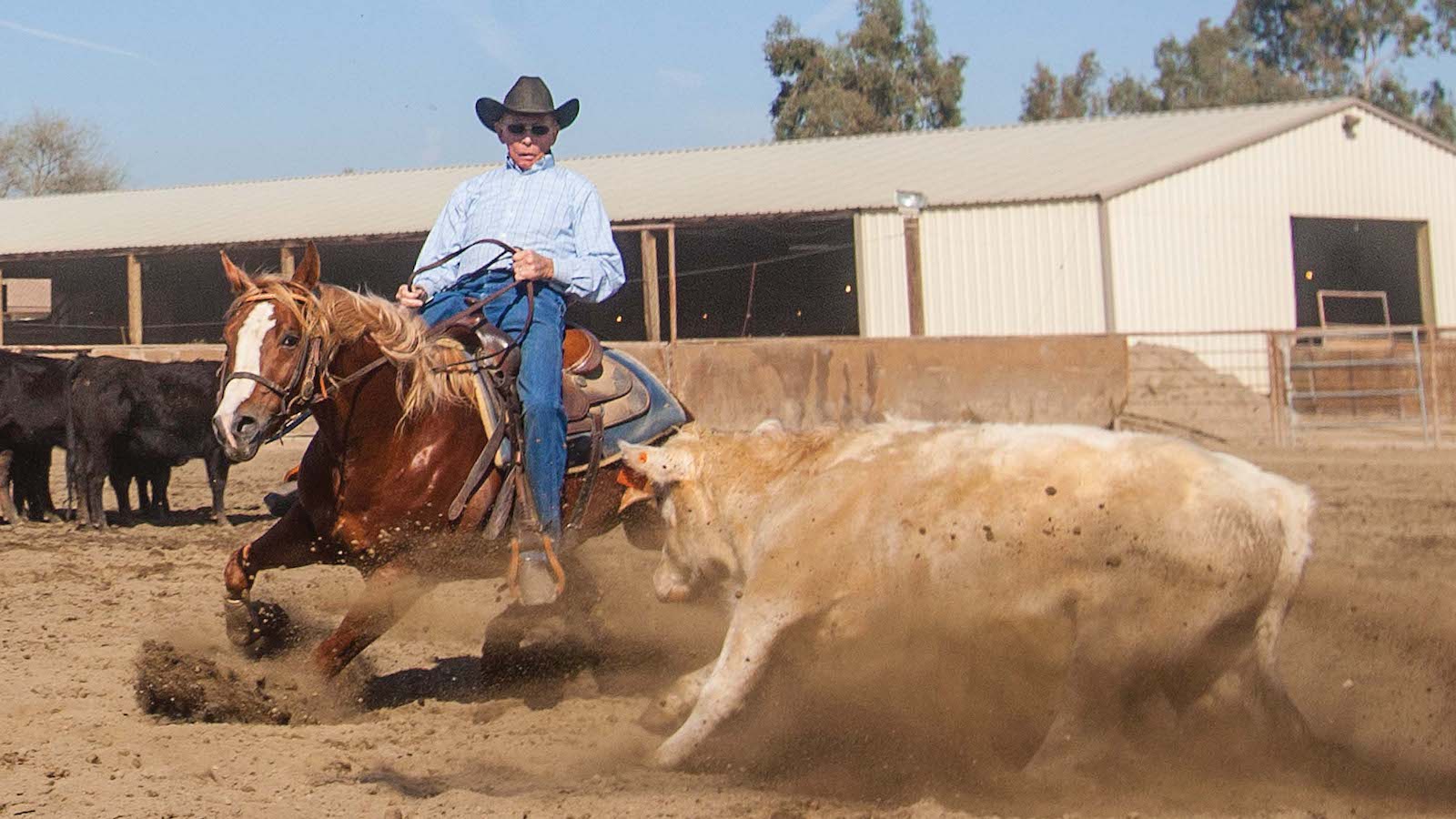
In the 1970s he began training horses full-time, accepting a job with High Horse Ranch in Nampa, Idaho. In 1990, the Tejon Ranch in Lebec, California, hired Doug to lead its horse program. Several years later, he established his own training operation in Bakersfield. He continues to train horses there today.
During the course of his career as a trainer, Doug has established himself as more than a great showman. Many respect him as a horseman.
“His whole life has been based around horses,” Gorrell says. “So every time you’re around him you’re always learning things. He’s got his own unique style. He doesn’t pick at his horses much. Doesn’t pull on them all the time.”
Carol says that her husband’s training approach results in a barn full of content horses.
“He wants them to like their job,” Carol says. “His horses have confidence in him. Doug doesn’t pick at them. He’s big on teaching them something and making it their responsibility to do it. He always gets onto me about handling my horse too much.”
“All my horses in my barn are happy,” Doug explains. “And it all comes down to respect. A horse that respects you is a happy horse.
“If you ride your horses every day, then you don’t feel like you have to catch up. It’s when you feel like you’ve fallen behind that you start beating them up a little bit to catch up. I try to develop their ability and a level of respect a little at a time, and that leads to a finished horse.”

Wow!! One very awesome Cowboy all his life!!!
Doug was the best training I ever knew. He was a great man.