

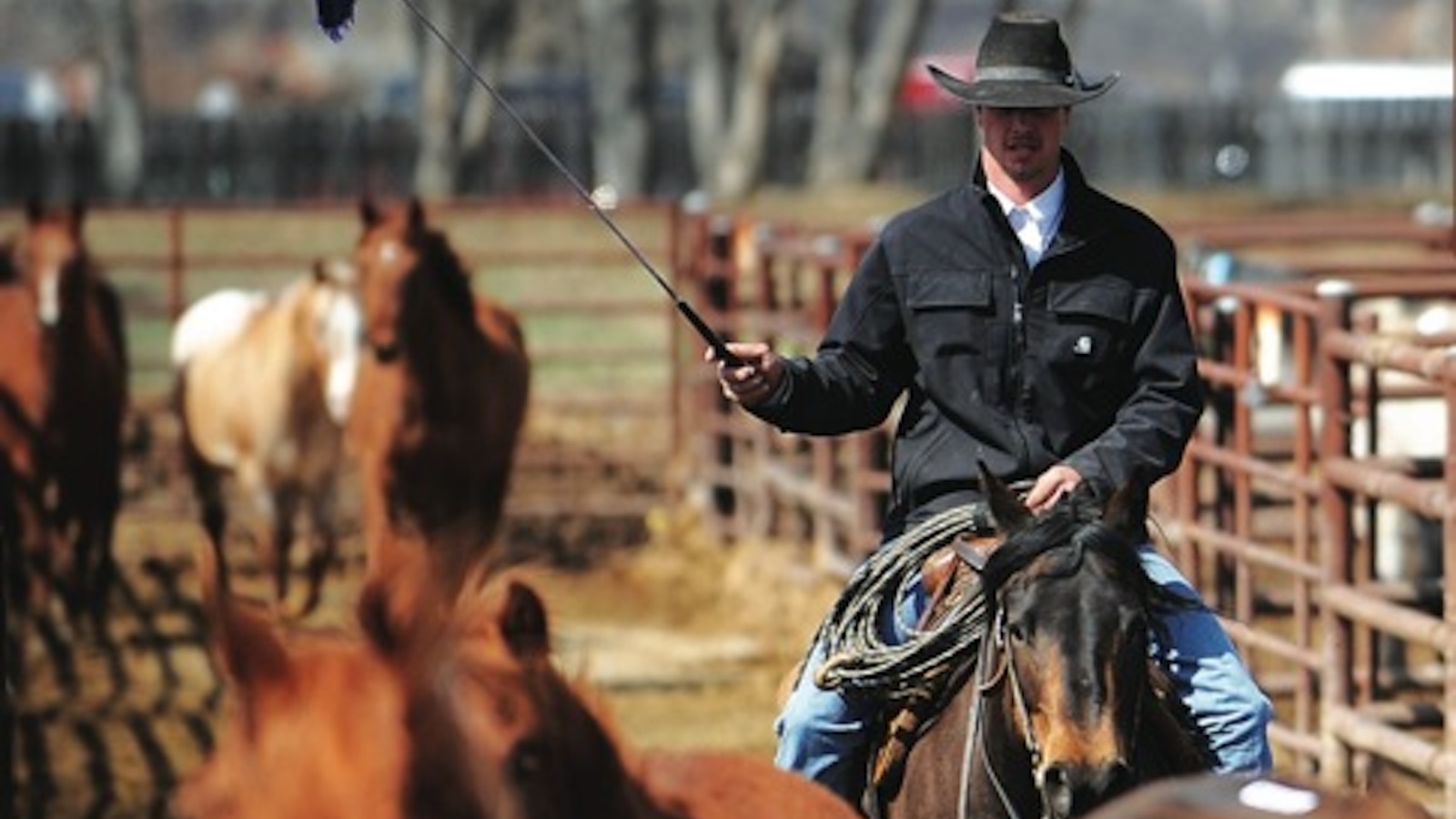
For many cowboys, working at a sale barn is the next best thing to getting a job on a big outfit. It’s also a perfect place to train reliable ranch horses.
Sunlight perforates the cloud cover and casts a reflective glow on cowhides steaming in the cool morning air. Everything is still. The only sounds are cattle munching hay, and somber, harmonic bellows. In the corner of a corral, a cowboy getting a jumpstart on the day saddles his horse.
It’s a quiet morning at the livestock sale barn, but within a few hours the yard will come alive as the weekly auction begins. You’ll hear the whoops of cowboys sorting cattle and sending them down the alley into the sale ring, hooves hitting hard ground with a cadenced clack, and chains clanging against squeaky metal gates. Above the din, the auctioneer’s voice booms.
It’s not exactly the serene setting one imagines for a cowboy job, but as large ranches consolidate or dissolve and pastures are subdivided, many cowboys are left searching for work. That’s when they show up — horse and saddle in tow — at a local livestock sale barn.
“It’s the best thing between living in town and on a ranch,” says Mike Sikveland, a member of the yard crew at Billings Livestock Sales in Montana.
Sikveland, like many of the men and women who make a living at sale barns, has spent much of his life working in feedlots and doing ranch work. Employment opportunities and family responsibilities often force a working cowboy to move closer to town.
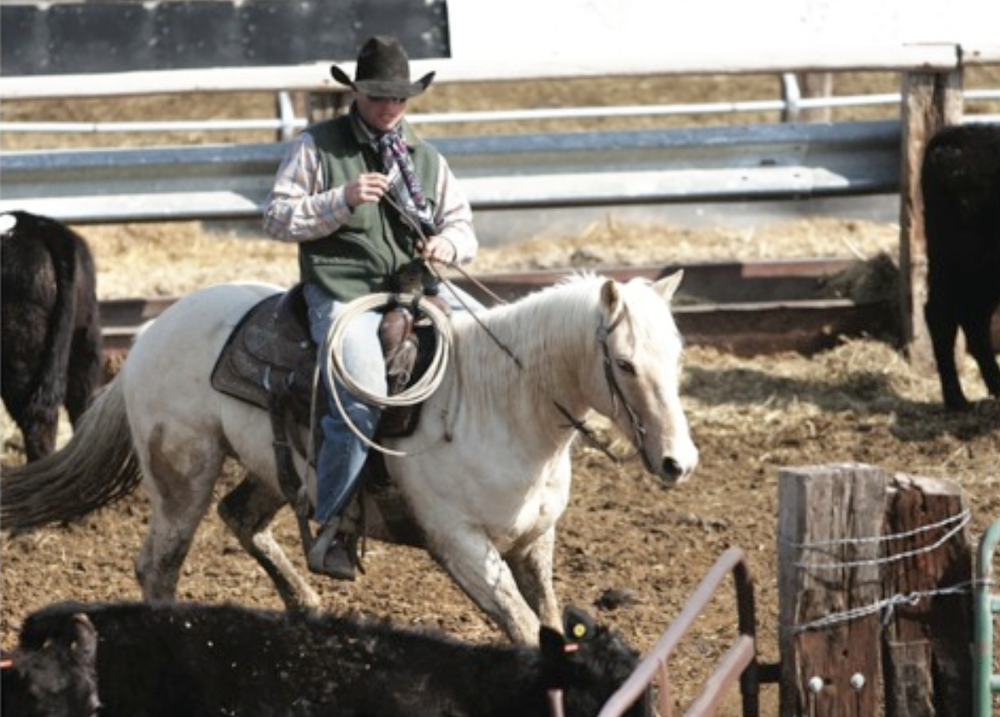
Experience with horses and cattle are valuable when it comes to working at a sale barn, but are not mandatory. A sale-yard cowboy’s job description differs from that of a straight-riding ranch job. The sale yard action is fast-paced, unpredictable and sometimes downright dangerous, and those who work there are never going to get rich. But the pluses of the job, such as being horseback every day and the opportunity to put a handle on a horse, far outweigh the perils.
ON SALE DAY, you’ll find Skveland in the center alley, pushing herds of presorted cattle into the sale ring. His priority is to get the livestock into the ring as quickly and safely as possible. Before the cattle enter the ring, he counts the animals and makes sure the number matches the one listed on a card he pulled off the pen. This important document, often referred to as “mail,” is commonplace in sale yards. It lists critical identification information, such as the number of cattle in the pen and the consigner’s number. The paper is handed from crewman to crewman as the cattle change pens.
Everything Sikveland does at the yard is horseback. He brings two to four horses to ride each day, a mix of seasoned ranch horses to young prospects.
“I break a lot of colts at the yard,” he says. “Even if they’re not bred to work cattle, they learn to watch a cow because the alleys are so narrow that they don’t have a choice but to watch them. They’re also around so much commotion, blowing objects and loud machinery. When a horse leaves the sale yard, he’s ready for just about anything.”
The sale yard also is a good place to see if a horse will hold up mentally and physically to hard work and undesirable ground conditions.
“The alleys at BLS are textured concrete, so I look for horses with good feet and legs,” says Sikveland. “If their legs aren’t stout enough to support them on the concrete, it’s a good indication they won’t hold up to the stress of ranch work.”
To help his horses remain sound, Sikveland keeps them shod year-round and applies borium to the horseshoes for increased traction. In the winter, the alleys are cleared of snow and ice, sanded and salted, but the slightest patch of ice can be dangerous for horse and rider. When conditions aren’t conducive to riding, the crew relies on stock dogs to get the job done.
IN THE SORTING ALLEY at BLS, 29-year-old Russel Moser cuts cattle and puts them in groups with similar traits. The grandson of BLS owner Pat Goggins, Moser developed an eye for cattle at an early age. Sorting is one of the hardest jobs at a sale barn and requires a keen eye for cattle. Sorters look at such characteristics as color, size and gender, and group similar cattle to achieve the uniform lots cattle buyers desire. Cattle that don’t fit into a group are sorted off and sold as singles.

As soon as Moser sorts the cattle into different pens, he hangs the mail on the pen for the next person, who takes them to the next set of pens and so forth. Efficiency in the sale yard requires impeccable communication and teamwork, with small margin for error.
“I’m always talking to the guys in the center alley and telling them which pens of cattle to send into the ring first,” Moser says. “They usually know anyway because we’ve all worked together for a while and have a system.”
That system ensures the sale flows seamlessly. If the sale has to stop for some reason, it loses momentum, buyers become distracted or leave, and prices drop.
Moser rides two or three horses a day at the sale yard. In the morning, when most of the fast-paced sorting occurs, he rides his experienced horses. During slower times, he gets on younger horses that learn better while working smaller herds of cattle at a slower pace. He buys most of his horses at BLS’s monthly horse sales, looking for young prospects that have seen cattle and have been on a ranch, but need training. Once the horses are solid sale-yard citizens, he resells them for a profit.
“The yard is a good place to start young horses,” he says. “It’s a confined environment where they can’t get away from you. They learn to watch cattle quickly because they’re so close to them. They also see a lot of cattle and are put in different situations.
“Working cattle is unpredictable, and there are risks. You never know what they might do, so both you and your horse have to be alert and ready for anything to happen.”
Because of the fast, dynamic nature of his job, Moser rides his horses in snaffles. That allows him to be lighter and gentler on their mouths when making sudden moves. He, like most sale-barn cowboys, carries a rope on his saddle horn, but rarely uses it because of the close quarters.
“Once in awhile, a cow will get out and go into the parking lot or onto the frontage road, or one won’t go into the ring, so I will go rope it,” he says. “Most of the time I use a stock whip when sorting cattle, so my horse gets used to that.”
A full-time sale-barn employee, Moser usually spends three days a week sorting cattle. The rest of the week, he works on his family’s ranches, which gives his horses a break from the commotion and confinement of the sale yard.
“After a while, the horses want to get out and cover some country, rather than being cooped up in the sale yard,” he says. “Changing their routine does wonders for their minds.”

WORKING AT A SALE BARN is seasonal employment for many of the yard hands. The busiest times of the year are the fall and spring, and that’s when most sale barns hire extra help. During the summer, when most cattle are on pasture, the crew is cut back.
Dean Brainard had years of experience working on ranches and at a sale barn before moving to Billings and getting a job at BLS — what he thought would be a temporary stay until he found gainful employment.
“That was in 2006, and I haven’t had time to go look for a job since,” he says.
The variety of work at the sale barn appeals to Brainard. He spends time horseback in the yard’s back alley, penning cattle when they come out of the sale ring, as well as afoot cleaning pens and water troughs, and feeding. This spring on BLS owner Pat Goggins’ ranch, he helped gather more than 500 purebred yearling heifers, then rode morning and night checking for those ready for artificial insemination.
Brainard says riding on the yard’s back crew is a great way to teach a horse to track cattle, open gates, rate and maneuver in tight spaces. Everyone has differing opinions on working cattle, but Brainard still believes horses are best at the sale yard.
“They alleys are a quarter-mile long, and we have to take the cattle to their pens at they exit the sale ring and then hurry back for the next group,” he explains. “We don’t do a lot of long-distance riding like on a ranch, but we have to be as quick and efficient as possible.”
The sale barn suits Brainard just fine, but that’s not the case with some cowboys.
“What we do in the stockyard isn’t correlated to cowboying in the open,” he explains. “Some guys who come from ranches can’t make the transition into the confined, fast-paced environment.”
This article was originally published in the July 2011 issue of Western Horseman.